Get Full Government Meeting Transcripts, Videos, & Alerts Forever!
Get email alerts on the Film Rebate topic
No spam. Unsubscribe anytime.
San Francisco amends film rebate to bar rebates for productions that began before ordinance takes effect
Summary
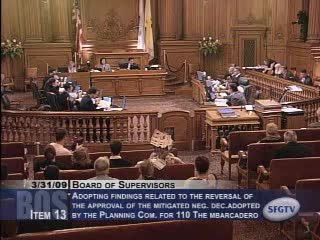
After hours of debate over jobs, city spending and possible conflicts of interest, the Board of Supervisors voted to amend the city's film-rebate ordinance so the new rebate terms apply only to productions that begin on or after the ordinance's effective date.
San Francisco's Board of Supervisors on March 31 amended an ordinance that reshapes the city's film-rebate program, voting to limit the revised rebate terms to productions whose filming commences on or after the ordinance's effective date.
The amendment, proposed by Supervisor John Avalos and seconded by Supervisor Chris Daly, specifies that "rebates paid under this ordinance ... shall be paid only to those qualified film productions whose filming commenced on or after the effective date of this ordinance." The board approved the ordinance as amended on first reading; the amendment passed on a roll-call tally of 10 ayes and 1 no.
Supporters framed the measure as an economic stimulus tailored to preserve local film jobs while clarifying and capping a program that city officials said had been confusing. "This is an economic stimulus bill," said Stephanie, a representative of the city's film office, telling supervisors the changes were intended "to do an administrative fix and make the program better, both for productions as well as ... for the city." She said the film office had worked on amendments for more than a year and had shared First Source hiring agreements with current productions to encourage local hiring.
Supervisor Avalos, who proposed the amendment, said he was concerned that allowing the new rebate rules to be applied retroactively would use scarce city resources to subsidize a production already enticed to film in San Francisco under the prior rules. "We're facing budget cuts to key services," Avalos said. "Let's try and make sure that we can hold on to as much general fund money as we can to save some of our key services in the city." He and other speakers said the rebate program as reconfigured includes a cap on the size of individual rebates (discussed on the floor as up to $600,000 per production) and that the program is funded from a set-aside rather than newly drawing on the general fund.
Opponents said excluding the already-underway pilot from the amended rebate could reduce San Francisco's leverage to keep a potential long-running television series in the city. "The major value of this to the city is a long-term project in San Francisco that has real sustainable jobs," said Supervisor Carmen Chu, urging the board to apply the new terms to the pilot as well. Film office representatives and supervisors cited prior local productions'noting Milk created roughly 250 jobs'and estimated a successful series could create more sustained positions.
The deputy city attorney, Cheryl Adams, addressed the mechanics of the change on the floor: "The effective date of legislation is generally 30 days from the time that the mayor returns it and returns the legislation signed," she said, adding that the board may legislate whether new rebate terms apply retroactively or only going forward. The amendment clarifies that the board intended the new rebate to apply prospectively.
Discussion also touched on campaign finance and appearances. Supervisor Ross Daly pointed to recent donations from executives at NBC and said those contributions raised concerns about the appearance of influence; Daly characterized the donations as raising questions about "the integrity of the political process." Board members who opposed that line of attack said the ordinance had been in development for years and was intended to attract film industry jobs to the city.
The ordinance before the board amends Administrative Code Section 57.8 to modify the cap on the amount an individual production can receive under the rebate program. On first reading the ordinance passed as amended; supervisors indicated the changes are meant to clarify eligibility, streamline administration and place a per-production cap on rebates while maintaining a role for First Source local-hiring commitments.
The matter is scheduled to return for final passage in a subsequent session, at which point the mayor's signature and the standard 30-day effective period will determine the formal start date for the new rules.