Get Full Government Meeting Transcripts, Videos, & Alerts Forever!
Get email alerts on the Land Use Development topic
No spam. Unsubscribe anytime.
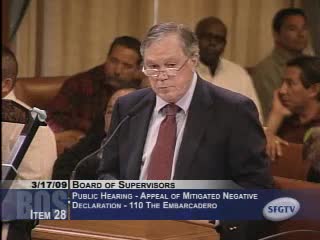
Board of Supervisors reverses Planning Commission on 110 The Embarcadero environmental clearance after heated hearing
Summary
After a multi-hour public hearing with historians, labor leaders and planning staff, the San Francisco Board of Supervisors voted to reverse the Planning Commission's adoption of a mitigated negative declaration for the proposed 110 The Embarcadero project and directed the clerk to prepare findings to that effect.
The San Francisco Board of Supervisors voted on March 17 to reverse the Planning Commission's adoption of a final mitigated negative declaration (MND) for the proposed development at 110 The Embarcadero, a move that removes the MND as the project's environmental clearance and directs staff to prepare findings reversing the commission's action. The reversal followed a nearly three-hour public hearing that drew labor leaders, preservationists, architects and the project sponsor.
The Board's action came after appellants argued the site's links to the 1934 longshoremen's strike and other concerns raised a fair argument that the project could have significant environmental impacts that require preparation of an environmental impact report (EIR). "This project is the first project to break the height restrictions on the waterfront, to do a spot rezoning for height," said Sue Hester, attorney for San Franciscans for Reasonable Growth, arguing that the development raised multiple issues including consistency with waterfront planning, shadow impacts and historic significance.
Planning staff countered that the department and its consultants had concluded the MND was adequate. Tim Frey, preservation technical specialist in the Planning Department, told the board staff considered the property eligible under an events-based criterion but concluded the building had lost sufficient integrity to qualify as a historic resource under CEQA. "Based on their evaluation, we feel confident'the building has been substantially altered since the period of significance and doesn't have the integrity to be eligible under CEQA," Frey said during the hearing.
Project counsel urged the board to accept the MND, saying consultants had documented the site and proposed mitigation measures. Michael Burke, lawyer for the project sponsor (Hines), said the mitigation measures and the historic documentation prepared by Page & Turnbull supported the Planning Department's approach and suggested an EIR would simply replicate work already completed.
Appellants and a wide range of preservation and labor witnesses disputed the department's integrity conclusion. Multiple historical witnesses described the site's role in the 1934 maritime strike and the general strike that followed, saying the building remains an associative landmark for labor history. Architectural historians who testified for the appellants said exterior features remain that can convey the site's historical association.
After deliberation, the Board adopted a motion reversing the Planning Commission's adoption of the final MND and directed the clerk to prepare findings to that effect. The motion passed on a 8-3 roll-call vote. The effect of the vote is to remove the MND as the project's environmental clearance, leaving the project without the adopted MND and positioning the city to prepare an EIR or otherwise respond to the board's reversal.
Why it matters: The site at 113 Stewart / 110 The Embarcadero is downtown and adjacent to the Embarcadero promenade; board members and many speakers framed the decision as covering three core concerns: whether a single-property height reclassification would set a waterfront precedent; whether the project's massing will cast new shadow on public waterfront spaces; and whether the site's association with the 1934 strike makes the property a historic resource requiring an EIR before demolition.
What the Board did and next steps: The board's reversal requires staff to prepare findings that explain the basis for reversing the Planning Commission's MND action. The reversal does not itself approve or deny entitlements (rezoning, permits) for the project; those land-use decisions would come separately and still require the board's approval. The reversal increases the likelihood the city will prepare a fuller environmental review document (an EIR) before final land-use approvals.
Voices from the hearing: Appellant attorney Sue Hester argued the project raised multiple, separate grounds requiring an EIR, including plan consistency, shadows and migratory-bird risk. "One issue is enough to trigger the requirement for an EIR, and we have four of them," she told the board. Planning preservation specialist Tim Frey said the department found the structure had been substantially altered and lacked the integrity required to be a CEQA historic resource. Project counsel Michael Burke said qualified consultants and planning staff had already done the necessary documentation and recommended denial of the appeal.
Votes at a glance (select outcomes on this meeting agenda): - Item 30 (motion reversing the Planning Commission's adoption of the final mitigated negative declaration for 110 The Embarcadero): Outcome: approved (reverse adoption); vote 8 ayes, 3 noes. Effect: removes MND as clearance; clerk directed to prepare findings reversing Planning Commission action. (Transcript timing: special order hearing at 04:00; reversal motion and vote in latter part of hearing.) - Item 31 (motion directing clerk to prepare findings reversing the Planning Commission): Outcome: approved alongside item 30; same tally.
Other notable formal outcomes from the March 17 meeting (see full meeting minutes for roll-call tallies): item 15 (redevelopment budget reprogramming for Fillmore Jazz Preservation District) adopted (7 ayes, 4 noes); items 18 and 19 (GoSolar SF program amendments and related appropriation) passed on first reading after amendments (item 18: 10 ayes, 1 no; item 19: 9 ayes, 2 noes); item 21 (ordinance to require Rec and Park to maximize water use efficiency and use recycled water where available) passed on first reading (9 ayes, 2 noes); item 25 (appointment of David Chu to the San Francisco Bay Conservation and Development Commission) approved (7 ayes, 2 noes). (Transcript contains full roll-call records for each item.)
Context and limitations: The board's reversal addresses only the adequacy of the Planning Commission's environmental determination (the MND). It does not itself grant building permits or a rezoning; those land-use entitlements must be considered separately. The board's findings will be published in the administrative record once prepared by the clerk.
Ending: The project sponsor and opponents now face a procedural path that will likely include an EIR or other additional environmental documentation. That process will add time and public review before any final land-use approval for the 110 The Embarcadero development.