Get Full Government Meeting Transcripts, Videos, & Alerts Forever!
Get email alerts on the Budget Midyear topic
No spam. Unsubscribe anytime.
Board hears hours of public testimony on midyear budget cuts; considers special election for revenue
Summary
The Board of Supervisors spent much of its Jan. 27 meeting debating the mayor's midyear spending cuts, heard more than 200 public comments protesting proposed reductions to health, human services and community programs, and took procedural steps toward a possible June special election to ask voters for new revenue.
Lede: The San Francisco Board of Supervisors spent much of its Jan. 27 meeting taking public comment and debating Mayor Gavin Newsom's midyear budget cuts, with dozens of advocates warning the reductions would close programs for homeless services, mental health, juvenile programs and substance-abuse treatment.
Nut graf: Supervisors and dozens of service providers described the cuts as immediate and deep, repeatedly urging the board to put a revenue measure before voters this spring rather than let the mayor's package, which includes furloughs and layoffs, take effect. The board voted to hold further committee hearings and to consider modifying election deadlines so a June special election could be possible, while public speakers urged immediate restoration of particular services.
Body: The meeting turned into an extended public-hearing session after Supervisor Chris Daly moved an —amendment of the whole— that would strike roughly $8 million in proposed health cuts from the mayor's midyear package and replace them with targeted reductions elsewhere. Daly framed the change as an effort to protect core health and safety services while the board and the public consider whether to ask voters for revenue.
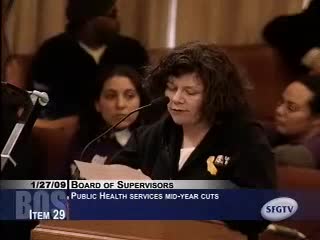
Dozens of public speakers lined up during the committee-of-the-whole portion of the meeting. Speakers included nurses, social workers, nonprofit directors and clients of services who described program closures slated for Feb. 20. Testimony highlighted potential harms if the cuts proceed: longer emergency-room waits, loss of forensic nursing for child abuse investigations, reduced substance-abuse treatment and fewer in-home supports for seniors. Advocates for the arts also testified that steep reductions to cultural institutions would jeopardize jobs and community programs.
Supervisor Chris Daly and other members said the board needs more time and a broader approach than the mayor's midyear plan provides. Daly and others proposed a package of alternative cuts and asked the board to pursue a voter-approved revenue measure in June so cuts would not fall solely on frontline services.
City staff, the city attorney and the budget analyst presented technical constraints: some cuts cannot be undone quickly, some contracts are state- or federally funded and would be affected if positions are eliminated, and certain changes would trigger required hearings (for example, statutorily required hearings before reductions to some public-health services). The budget analyst repeated the administration's warnings that moving to a competitive procurement or reissue of contracts could cause months of delay and added costs.
Board action and next steps: The board voted to convene as a committee of the whole to continue detailed hearings and to consider emergency ordinance language to modify the municipal election code deadlines so measures could reach a June ballot if the board decides to pursue that route. Supervisors debated whether June gives enough time for a complex revenue-and-savings package to be developed and vetted; no revenue measure was put on the ballot at the meeting.
Ending: The meeting closed after more than three hours of public comment. Supervisors said they would continue joint hearings, seek more financial analysis, and weigh whether to refer one or more revenue proposals (and related charter or code changes) to a June special election; they scheduled further committee-of-the-whole sessions to examine midyear cuts, alternatives and their fiscal consequences.
Quotes used in this article are verbatim from the meeting transcript.