Get Full Government Meeting Transcripts, Videos, & Alerts Forever!
Get email alerts on the Liquor License Transfer topic
No spam. Unsubscribe anytime.
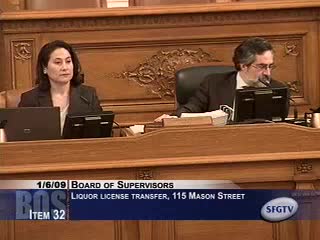
Supervisors approve transfer of Union Square Sports Bar liquor license with conditions after police urged denial
Summary
The Board of Supervisors approved the transfer of a type-48 public premises liquor license to 115 Mason Street with strict operational conditions after the Police Department recommended denial; supervisors later removed a new requirement that on-site security staff hold a specific state guard card.
The San Francisco Board of Supervisors approved the transfer of a type-48 on‑sale general public premises liquor license to 115 Mason Street, approving a package of conditions the Police Department proposed even as the department recommended denial.
The panel voted to adopt the license transfer and attached conditions after a lengthy discussion about community safety, noise, and proximity to residences. Inspector Dave Falzon of the San Francisco Police Department listed 16 conditions the department would seek if the board approved the transfer, including hours of alcohol service limited to 10 a.m. to 2 a.m., a prohibition on alcohol sales for off‑premise consumption, a no‑loitering requirement, graffiti removal within 72 hours, minimum interior and exterior lighting standards, and a requirement to keep at least two surveillance cameras with recordings retained for at least two weeks.
"The police department is still recommending this application for denial, but in the event the board elects to approve it, we are" proposing the conditions, Inspector Falzon told the board and outlined specifics. He also proposed that the premises keep at least two operational surveillance cameras and that recordings be maintained for a minimum of two weeks.
Supervisor David Chiu moved to approve the transfer with the conditions; Supervisor John Avalos (listed in the transcript as the motion second under Supervisor Ellsberg) seconded the motion. The board initially voted to separate three conditions (the training/employee education condition, the surveillance camera requirement and the requirement for a security guard) from the rest of the package and adopt the remainder unanimously. On the separated conditions the vote was split during the first round of voting.
After further discussion and follow‑up conversations between supervisors and the property owner, Supervisor Mark Daly proposed removing one sentence in the security‑guard condition that would have required the guard to "maintain a valid guard card from the California Department of Consumer Affairs." The board voted to strike that sentence and then adopted the resolution as amended. The final recorded vote on the amended resolution was 10 ayes, 0 noes.
The package of conditions that remains part of the approval includes limits on hours (10 a.m.–2 a.m.), prohibitions on under‑21 access while alcohol is served, bans on off‑premise alcohol sales, no street seating or expansion onto sidewalks, required ABC (Alcoholic Beverage Control) licensee education for employees, minimum interior and exterior lighting standards to avoid disturbing neighbors, a two‑camera minimum with retained recordings, graffiti removal obligations, a prohibition on structural changes without ABC approval, a litter‑removal obligation, and a restriction on exterior advertising that promotes alcoholic beverages.
The Police Department emphasized that its recommendation remained denial, but Falzon said the department prepared the list of conditions "in the event the board elects to approve" the transfer. Supervisors who supported the transfer cited the applicant's prior record and community outreach; supervisors who objected cited neighborhood proximity to housing and public‑safety concerns.
The resolution passed as amended; the record shows subsequent clarifying language removing the guard‑card requirement but leaving in the on‑site security requirement and other operational conditions.