Get Full Government Meeting Transcripts, Videos, & Alerts Forever!
Get email alerts on the Land Use Power Plants topic
No spam. Unsubscribe anytime.
Board requires conditional-use review for large power plants, with questions about state preemption
Summary
The Board of Supervisors voted to require conditional use authorization for power plants over 10 megawatts in M1 and M2 zoning districts, a change proponents said would extend public review to facilities previously permitted as of right; planning staff and the city attorney noted potential state preemption issues to resolve for specific projects.
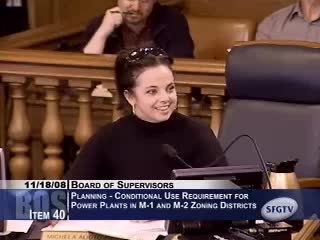
The San Francisco Board of Supervisors voted to require conditional use authorization from the Planning Commission for new or expanded power plants larger than 10 megawatts in M1 and M2 zoning districts.
Supporters said the measure closes a gap that allowed power plants to be built as-of-right in industrial districts without the public review normally required for other major land uses. "This legislation corrects this imbalance in the code by establishing a CU requirement for all new and existing power plant facilities," Supervisor Sophie Maxwell said during debate.
The Planning Department’s staff told supervisors the ordinance distinguishes between smaller renewable generation and larger plants: facilities under 10 megawatts would be permitted as of right, while those over 10 megawatts would require conditional use authorization and review against the ordinance’s specified criteria. Planner Maris Sullivan Lanay said the 10-megawatt threshold was chosen after department review and discussion with institutional users to avoid imposing extra permitting burdens on smaller rooftop or building-mounted systems.
Several supervisors asked whether existing proposals — including combustion turbine projects discussed in the City — would be affected or preempted by state law. The Planning Department said that any unit that meets the ordinance’s definition of a power plant would require a conditional use authorization; Deputy City Attorney Cheryl Adams said the department’s approach was "correct," but acknowledged the possibility of state preemption questions under energy licensing statutes (the Warren‑Alquist Act was cited during discussion). Adams and Sullivan Lanay said CEQA and other environmental review would still apply and that some technical preemption issues should be reviewed by the city attorney’s energy experts.
Supporters argued the change would not block renewable generation or community choice aggregation projects but would provide a public forum for discussion of large installations. "A CU requirement is one that ensures certain public procedures," Maxwell said. "This process requirement would not put renewable projects at any specific disadvantage but would still provide the opportunity for community dialogue around significant projects."
The Board passed the ordinance on first reading by roll call; the Clerk recorded 11 ayes. The ordinance will return for the second reading and final passage at a later meeting.
Why it matters: The change shifts major power‑generation projects into a public land‑use review process, increasing opportunities for neighborhood input on siting, emissions, water‑use and related impacts. It also raises questions about the limits of local land‑use control where state energy permitting law may apply.