Get Full Government Meeting Transcripts, Videos, & Alerts Forever!
Get email alerts on the Ceqa topic
No spam. Unsubscribe anytime.
Board affirms Planning Department exempt determination for Golden Gate Avenue project after public hearing; disapproval motion fails
Summary
After a public hearing on the CEQA appeal for a proposed fire-escape and deck reconfiguration at a Golden Gate Avenue building, the Board of Supervisors affirmed the Planning Department's categorical-exemption determination. A motion to disapprove the exemption failed; the board approved the department's exemption and directed findings.
A public hearing and appeal over a Planning Department categorical-exemption determination for a project at 1980–1998 Golden Gate Avenue concluded on Oct. 7 when the San Francisco Board of Supervisors affirmed the department’s determination that the project was categorically exempt from further California Environmental Quality Act (CEQA) review.
The appeal raised preservation and safety arguments. Appellant counsel and multiple tenants said the application to remove existing rear wooden decks and stairs and to add a front-mounted metal fire escape would adversely affect a potentially historic building and could leave several units without a lawful second means of egress. The appellant asked the board to find the department’s exemption inadequate and to require additional environmental review.
Planning department and sponsor testimony
Planning Department staff said the building was treated as a potential historic resource for CEQA purposes because it is older than 50 years and the department’s preservation technical specialist reviewed the proposed work for consistency with the Secretary of the Interior’s Standards. The planner, Matt Weintraub, told the board the project would affect fewer than two of the five bays on the primary facade, would alter only three of 18 openings on that facade while retaining the overall fenestration pattern, and that the department concluded the project would not cause a substantial adverse change to the potential historic resource. The department acknowledged a processing error in which the categorical-exemption stamp was not physically applied at review time and issued a memo in September to document the CEQA determination.
Project sponsor representatives said the rear wood decks and stairs had structural dry rot and fire-safety issues. They said a front-mounted metal fire escape would provide a code-compliant means of egress and that installation would avoid vacating units that otherwise would have to be taken off-line for repair.
Public testimony
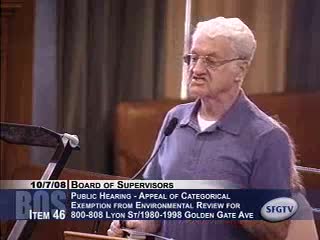
Tenants and neighbors described long-standing maintenance concerns and said boards had fallen from the structure. Tenants told the board they were worried a change in configuration would remove rear egress routes and would make their units less safe or trigger code-based vacancy or eviction. Appellant counsel said planning’s prior Board of Permit Appeals history and the permit path warranted further review.
Board actions and votes
- Motion to disapprove the Planning Department’s categorical-exemption determination (item 48): roll-call 3 ayes, 6 noes — motion failed. - Motion to affirm the Planning Department’s categorical-exemption determination (item 47) and to direct the Clerk to prepare findings (item 49): approved (roll-call 6 ayes, 3 noes). The board’s action therefore left the CEQA exemption in place and directed official findings be prepared.
Why it matters
The hearing juxtaposed two concerns: historic-preservation impacts under CEQA and building-safety/egress problems asserted by tenants and the sponsor. Planning’s preservation review found the proposed changes compatible with Secretary of the Interior standards for altered resources, and the board ultimately deferred to that analysis, while also recording tenant safety concerns in the public record.
Speakers and roles (selection)
- Victoria Wise, Environmental Exemption Coordinator, Planning Department - Matt Weintraub, Preservation Technical Specialist, Planning Department - Trent Rohrer (noted earlier in meeting as HSA director) appeared elsewhere; in this hearing, appellant counsel and project sponsor representatives testified along with tenants.
Next steps
Clerk was directed to prepare findings related to the board’s action. The exemption remains operative unless future legal challenges or substantive new facts alter the analysis.