Get Full Government Meeting Transcripts, Videos, & Alerts Forever!
Get email alerts on the Utilities Water Sewer topic
No spam. Unsubscribe anytime.
Supervisors debate allowing landlords to pass through half of post-2002 water and sewer rate increases; item continued to Nov. 18
Summary
The Board of Supervisors debated an ordinance that would allow landlords to pass through up to 50% of water and sewer rate increases adopted after July 1, 2002. After an initial failed attempt to continue consideration, the board approved a motion to continue the item to Nov. 18.
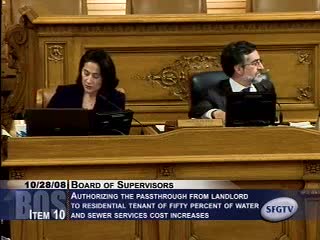
The San Francisco Board of Supervisors on Oct. 28 debated an ordinance from the Land Use Committee that would amend the administrative code to permit landlords to pass through to tenants 50% of increased water and sewer charges resulting from rate changes adopted after July 1, 2002. After a contentious exchange, the board voted to continue the item to Nov. 18.
Supporters and critics disagreed over whether the change would promote conservation or risk double-charging tenants. Supervisor Elsberg moved to continue the item to Nov. 18; Supervisor Dufty seconded. That motion failed in an initial roll call. After additional discussion and a substitute motion to continue, the board approved moving the item to Nov. 18 by a 6–5 vote.
The ordinance would allow landlords to pass through one-half of any increase tied to new water and sewer rates adopted after the specified 2002 date. Opponents, including Supervisor Duffy during debate, said they worry the change could amount to double charging when other rate mechanisms are in place and that the city’s long-term conservation goal should be greater individual metering. "The bottom line being that ultimately, what we need to do is have more individual metering because long term, we do need to promote conservation," Duffy said during public remarks on the item.
Supporters and other supervisors urged additional departmental coordination and attention to hardship cases. Supervisor Chu said she planned to support the ordinance but asked that implementation consider owners’ access to abatement resources and that provisions account for hardship cases so enforcement would not create unintended consequences for tenants.
Supervisor Maxwell said he intended to vote against the measure but was willing to agree to a continuance to allow more negotiation. The board did not adopt the ordinance on Oct. 28; instead, members directed that further work and discussion occur ahead of the Nov. 18 meeting.
The item will return to the board on Nov. 18 for further consideration and possible action.