Get Full Government Meeting Transcripts, Videos, & Alerts Forever!
Get email alerts on the Housing topic
No spam. Unsubscribe anytime.
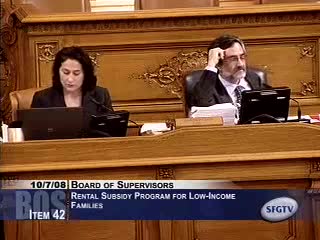
Supervisors split on rental-subsidy plan; ordinance fails first reading and is continued for more review
Summary
The San Francisco Board of Supervisors on Oct. 7 debated a proposed rental-subsidy ordinance that would let low-income families receive city rental assistance for up to five years with a sliding subsidy as incomes rose.
The San Francisco Board of Supervisors conducted an extended debate on Oct. 7 over an ordinance to create a rental subsidy program in the Administrative Code intended to stabilize low-income families’ housing. The proposed ordinance would have allowed families to remain on city-funded rental subsidies for up to five years, with the subsidy reduced dollar-for-dollar as household income rose, and create an oversight committee including program participants and service providers.
The proposal drew prolonged discussion from supervisors, residents and service providers about program length, exit strategies, obligations of case managers, and whether the program would inadvertently “time out” vulnerable families. At roll call the ordinance failed on first reading with a 5–5 vote. After board discussion, a motion to rescind that vote passed and the board then approved a two-week continuance to return with further information.
Key points from debate
- Sponsor’s intent: Supervisor Daly framed the proposal as a second attempt to structure rental subsidies so families would not be forced out of housing after a short period in a weak labor market. Daly said the draft differs from earlier versions by creating an oversight committee, allowing up to five years of assistance while tapering subsidies as incomes grew, and excluding one rapid-rehousing provider (the Hamilton program) so it could continue its own model. - HSA data and flexibility: Trent Rohrer, director of the Human Services Agency (HSA), told the board HSA reported 76 families had successfully exited to housing where they paid a share of rent; nearly three dozen had “failed” the program for noncompliance; about 214 families were currently participating. Rohrer said HSA retains flexibility under general-fund operation to grant exceptions and to provide case-management-driven extensions when appropriate, and that several hundred family units were expected in the pipeline that could help participants. - Advocates’ concerns: Advocates and supervisors warned that a fixed time limit (even five years) could create fear among participating families who lack pathways to stable income growth. Supervisors said immigrant families, those working multiple low-wage jobs, and families facing structural barriers could be unable to meet income goals within set time frames.
Votes and motions
- Ordinance (item 42) on first reading: roll-call vote — 5 ayes, 5 noes; ordinance failed on first reading. - Motion to rescind the failed vote (to allow reconsideration when a full complement of supervisors is present): moved by Supervisor Daley, seconded by Supervisor Ammiano; roll-call result 9 ayes, 1 no — motion to rescind was approved. - Motion to continue the item two weeks (to allow full review and more data): moved by Supervisor Daley, seconded by Supervisor Ammiano; motion carried and the item was continued two weeks.
Speakers and roles cited
- Supervisor Chris Daly (sponsor of the ordinance) - Trent Rohrer, Director, Human Services Agency (provided program data and described flexibility) - Supervisors Dufty, Mercarini, Ellsburn, Maxwell and others participated in the debate and asked for clarifications.
Clarifying details extracted
- Program duration proposed: up to 5 years for beneficiaries, with subsidy reduced dollar-for-dollar as income increased. - Program participants referenced: HSA reported 76 families graduated, ~30 who failed to meet program requirements, and approximately 214 families currently participating. - Oversight: proposed oversight committee to meet quarterly with program operators and participants.
Why it matters
The ordinance deals with how the city provides rental assistance to families exiting homelessness or at risk of housing loss. Supervisors expressed concern about balancing program urgency and limited funding with participants’ need for long-term stability. The board did not adopt the ordinance at this meeting; staff were directed to provide additional details as requested and the item was continued for further consideration.
Next steps
The item was continued for two weeks for additional information and outreach; the board did not adopt the ordinance on Oct. 7.