Get Full Government Meeting Transcripts, Videos, & Alerts Forever!
Get email alerts on the Zoo Governance And Animal Welfare topic
No spam. Unsubscribe anytime.
Board rejects amendment to zoo oversight bill after hours of debate; committee creation remains contested
Summary
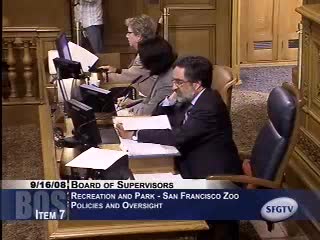
Supervisor Chris Daley moved an amendment to rewrite a proposed zoo ordinance to remove mandatory conversion language and instead create a Board‑appointed animal welfare oversight advisory committee, but the board voted down the amendment 4–7 after a multi-hour debate.
Supervisor Chris Daley moved an “amendment of the whole” to legislation that would create policy language addressing the future management of the San Francisco Zoo, saying the bill “is a vision document … that puts the needs of, and the well-being of, the animals, at the zoo first.” Daley said his amendment removed the bill’s “teethy” conversion language and instead emphasized creating an animal welfare oversight advisory committee to report to the Board of Supervisors and help shape future contract negotiations with the San Francisco Zoological Society.
Gabe Cabrera of the Office of Legislative Analyst summarized the OLA’s 23‑page report to the Board, saying most zoo practices “compare favorably” with standards from the USDA and professional zoo associations but with notable exceptions: some enclosures are outdated and “some of the zoo's animals may be suffering mentally and physically because their enclosures are outdated,” he told the Board. The OLA’s top recommendation was hiring an independent consultant to evaluate exhibit design, animal adaptive ranges, and indicators of stereotypic behavior, and to recommend changes if necessary.
Supervisors debated governance, funding and rescue-animal policy. Supervisor Bevan Dufty and others urged improved transparency and oversight of the joint zoo committee and the Rec and Park Commission. Supervisor McGoldrick—speaking in support of the OLA findings—commended staff work and emphasized a need for continued attention to the zoo’s conditions and programs. Several supervisors said the city lacks resources for large-scale capital work and emphasized the recent appointment of Carl Friedman to a leadership role focused on animal welfare.
Daley moved the amendment to delay “teethy” conversion language until future negotiations and to appoint a Board‑selected advisory committee to produce a report for successors prior to the next major lease renewal. Supervisor Mercarini seconded the motion. After roll call, the amendment failed on a 4–7 vote (4 ayes, 7 noes). The clerk recorded the vote as 4 ayes and 7 noes, and the amendment failed; the original legislation and next steps remained under discussion but without the amendment's requirements adopted at that meeting.
Supporters of stronger immediate restrictions said the proposed committee would be insufficient to effect timely reforms, while opponents argued existing bodies (the Rec and Park Commission, the joint zoo committee, and outside accreditation bodies such as AZA and USDA) provide oversight and that additional statutory constraints could be premature or counterproductive. Several speakers, including Supervisor Daley, said the board has time before the next lease renewal and sought an evidence‑based path forward.
No final passage of the underlying ordinance (as amended or unamended) was recorded on the floor during this meeting; the Board voted only on Daley’s amendment of the whole, which failed. Several supervisors said they would continue work with Rec and Park, the Zoological Society and community stakeholders and review consultant recommendations before any binding action on lease terms or conversions.
Why it matters: the zoo holds more than 200 species and has been the subject of public scrutiny after safety and animal welfare concerns. The OLA report recommended an independent technical review and better program evaluation for education and conservation efforts; the Board’s defeat of Daley’s amendment leaves unresolved the level of statutory constraints the Board will seek before the next major contract decision for the Zoological Society.