Get Full Government Meeting Transcripts, Videos, & Alerts Forever!
Get email alerts on the Affordable Housing Inclusionary topic
No spam. Unsubscribe anytime.
Supervisors vote to allow 25% of off-site inclusionary units outside one-mile radius; mayor's office and planning department raised concerns
Summary
The Board approved an amendment to the inclusionary housing rules allowing up to 25% of required off-site affordable units to be built beyond the current one-mile radius; the mayor's office and Planning Department warned of risks to integrated neighborhoods and enforcement challenges.
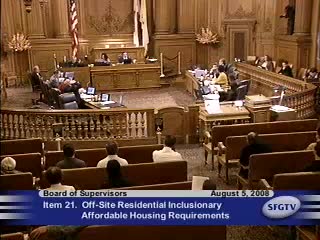
San Francisco — The Board of Supervisors on Aug. 5 approved on first reading an ordinance that allows up to 25% of off-site inclusionary housing units required from market-rate projects to be constructed outside the current one-mile radius from the principal development, with restrictions that the units not be in industrial zones or within a quarter mile of large publicly owned affordable developments.
Supervisor Sandoval, the item’s sponsor, said the change would give small but meaningful flexibility to locate affordable housing where land and financing make projects feasible, and to disperse affordable homes across the city. “This program is a very modest one, and it’s a small one,” he said, arguing the measure would help districts that have received little affordable housing.
Representatives from the mayor’s office of housing warned of potential pitfalls. Doug Schumaker of the mayor’s office said the office favors on‑site integration and that the one‑mile rule was adopted to avoid placing affordable units in remote or poorly served locations. Marilyn Melgaard of the mayor’s office of housing said the office administers the program and that the proposed one‑year averaging and two‑year build window raise practical enforcement questions. “In our experience, just pragmatically, two years is not enough time,” Melgaard said, referencing the time typically required to produce off‑site units and noting the ordinance is silent on enforcement if developers fail to deliver units.
Planning Department staff and the Planning Commission opposed the change, saying it was premature to alter the rules less than 18 months after the last overhaul and that the city’s planning goals favor integrated neighborhoods and on‑site inclusion. Araceli Malinane of the Planning Department said the commission and department “feel that it's a bit premature at this time to amend the 1‑mile radius.”
Supporters including Supervisors Dufty and McGoldrick said the measure is a limited tool to help get affordable units built in neighborhoods that have not seen investment, and stressed the change would not eliminate on‑site obligations nor the in‑lieu fee option administered by the mayor’s office of housing.
The ordinance passed on first reading by roll call, 7 ayes and 4 noes. The mayor’s office and Planning Department asked for additional implementation detail, including clarification of enforcement steps if developers do not complete off‑site units within the stated time frame.