Get Full Government Meeting Transcripts, Videos, & Alerts Forever!
Get email alerts on the Public Health Budget topic
No spam. Unsubscribe anytime.
Board holds packed hearing on proposed Department of Public Health cuts; community leaders warn of lost services and bigger costs
Summary
San Francisco supervisors heard hours of public testimony on Mayor's proposed cuts to the Department of Public Health, with scores of providers and clients warning that layoffs and program eliminations would put vulnerable residents at risk and shift costs to hospitals, jails and emergency services.
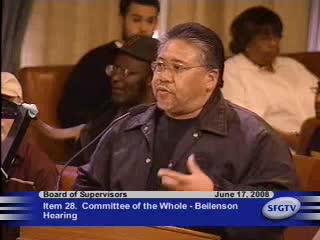
The San Francisco Board of Supervisors convened a committee-of-the-whole hearing on June 17 to take public testimony on the Department of Public Health's proposed budget reductions, during which providers, clients and advocates said the cuts would damage a fragile safety net.
The hearing, required under state law, focused on about 22 percent in proposed reductions to community behavioral health, substance abuse, specialty clinics and contracted nonprofit services. Hundreds of residents and agency staff testified that the reductions would close programs, reduce case management and transportation services, and force higher-cost care into hospitals and jails.
Why it matters: Testimony at the Belinson hearing described programs that providers say prevent costlier outcomes: detox and residential substance treatment, methamphetamine-focused programs, case management for homeless and mentally ill clients, outreach vans that transport people to care, the Trauma Recovery Center and the psychosocial medicine clinic. Speakers said cuts would likely increase emergency-room visits, hospitalizations, incarceration and unsheltered homelessness.
Providers and clients spent most of the afternoon describing program-level impacts. "The cuts that we're looking at this year are amongst the worst that I've seen in my 20 years of working in San Francisco," said Bill Hirsch of the AIDS Legal Referral Panel. "We are witnessing the dismantling of a system of care that has taken 25 years to build up to meet the needs of people who are incredibly vulnerable."
Service examples cited by witnesses included: - Mobile Assistance Patrol (MAP): a transportation hub and outreach van service that moves people from streets, shelters and detox to care. Janet Goi of Community Awareness and Treatment Services said MAP faced a proposed reduction that would eliminate vans and lay off staff, reducing daily transport capacity and leaving frail or mobility-impaired clients stranded. - The Stimulant Treatment Outpatient Program (STOP) and other methamphetamine programs: multiple speakers, including Michael Disapola and Michael Siever of the Stonewall Project, said recent federal grant losses plus the new local cuts would shrink meth treatment capacity that advocates link to HIV transmission prevention. "For every dollar spent on substance abuse treatment, the city saves $7 to $12," Siever said. - Psychosocial Medicine Clinic and Trauma Recovery Center at San Francisco General Hospital (SFGH): clinicians warned that closing the psychosocial clinic would undercut efforts to treat patients whose chronic medical conditions are made worse by untreated depression or anxiety; the Trauma Recovery Center faces a proposed shutdown that staff say would eliminate specialized care for victims of violent crime. - Community clinics, dental clinics and single-room-occupancy (SRO) tenant services: several speakers including dental staff from Southeast Health Center warned that cutting adult dental services would shift urgent dental problems into emergency departments.
Several nonprofit leaders warned of cascading effects: layoffs at contractor agencies would both reduce services and increase other municipal costs. Mary Kate Connor of Caduceus Outreach Services said that the nonprofit's budget, which previously covered medication, housing supports, case management and other lifesaving services, had been eliminated and "we will be forced to close our doors if this cut is not restored." She added that inpatient psychiatric holds and emergency-room stays are far more expensive than the community care Caduceus provides.
Supervisors acknowledged the gravity of the testimony and the difficulty of the budget year. Supervisor Chris Daly (commenting during opening remarks on the Belinson hearing) questioned the decision to conduct this statutory hearing at the board rather than before the mayor's office and urged more executive-branch presence to answer specifics. Several speakers asked Mayor's Office representatives and Department of Public Health officials for clearer line-item explanations and transition plans.
What the board heard about numbers and timing: Witnesses and providers repeatedly cited a 22 percent reduction figure frequently used in testimony. Multiple agencies described six-figure and seven-figure program cuts (examples given in testimony included cuts of $191,009 from MAP, six-figure losses at New Leaf and Walden House, and a $75,000 reduction at San Francisco Suicide Prevention). Providers said many of these reductions would take effect July 1 and that there was insufficient transition planning.
What officials said: Department of Public Health officials were present during the hearing; members of Mayor's budget staff and Controller's Office were noted as relevant to later budget deliberations. Supervisors on the budget committee said they were working to identify alternate revenues and restore programs as possible, but offered no immediate restorations at the hearing.
Next steps: The Board's budget committee continues markups and will take the mayor's proposed cuts under review in the coming weeks. Supervisors and advocates urged the board to restore services or find alternative revenue measures before July 1; providers warned that many clients would face immediate service loss if contracts are not funded.
Community context: Testimony highlighted populations most affected: people living with HIV, people who use methamphetamine, people experiencing chronic homelessness, seniors and people with severe mental illness, and tenants in SRO hotels. Witnesses also urged the board to consider the downstream criminal-justice and hospital costs of service reductions.
"If the goal is to save money in the short term," said a nonprofit director at the hearing, "you end up creating much larger costs in the long term in hospitals and jails." The hearing record will be part of the board's budget deliberations as it weighs restorations or alternative revenue options.