Get Full Government Meeting Transcripts, Videos, & Alerts Forever!
Get email alerts on the Criminal Justice Reform Community Courts topic
No spam. Unsubscribe anytime.
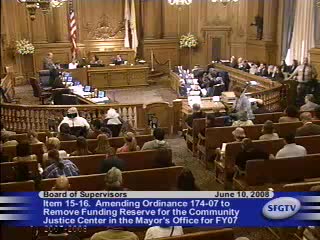
Supervisors refer Community Justice Center proposal to budget committee amid funding and service concerns
Summary
After hours of testimony from judges, advocates and residents, the Board referred the Community Justice Center (CJC) items to the budget committee for further review and fiscal analysis, citing concerns about cuts to social services and whether the court’s triage model has sufficient treatment capacity.
The Board of Supervisors voted to re‑refer proposals creating a Community Justice Center (CJC) to the budget committee after extensive testimony from judges, court officials, service providers and residents.
Judges and court leaders described the CJC as a problem‑solving court modeled on collaborative court practices (drug court, behavioral health court) that would handle misdemeanors and nonviolent felonies in a defined Tenderloin/SOMA area and link defendants to treatment, case management and supportive services. Commissioner Ron Albers and judges Harold Khan and David Pilati told the board they expect the court to improve treatment access, reduce jail bed days and save taxpayer costs over time; one estimate offered was potential jail‑bed savings of roughly $1.4 million for shortened pretrial detention times.
Opposition—particularly among several supervisors and many community‑based service providers—focused on the timing and the city’s budget context. Supervisor McGoldrick said the program’s first‑year annualized cost had been presented at roughly $2.9 million and stressed that concurrent proposed cuts to neighborhood service providers—some in the Tenderloin—risked leaving the CJC without the community treatment capacity it intended to use. Multiple speakers from neighborhood nonprofits and advocacy groups said providers are facing steep cuts and waiting lists for residential treatment; several warned that referring people to services that do not exist would set defendants up to fail.
Public defenders and court staff described a brief pilot calendar and limited initial results: the pilot held weekly calendars but many defendants did not appear for scheduled hearings; among cases that were heard a small number were referred to services. Public Defender Jeff Adachi told supervisors his office supported the collaborative court model provided participants’ constitutional rights are protected.
After debate supervisors moved, and the board voted, to re‑refer the relevant items (the appropriation ordinance amendment and the sublease/space authorization) to the budget committee so that the board could consider the CJC in the context of the city’s broader budget, service cuts, and updated cost reports. The re‑referral motion passed on a roll call of 7 ayes and 3 nos. The board asked the budget committee and controller’s office for updated, itemized fiscal analysis and for a clearer tally of projected annual and one‑time costs before any final approval.
The timetable: the budget committee will take up the CJC items during the fiscal deliberations; supervisors said they want more detailed cost estimates, evidence the needed treatment slots exist or will be funded, and clearer performance metrics (e.g., expected caseload, projected recidivism reductions) before the board considers final approval.