Get Full Government Meeting Transcripts, Videos, & Alerts Forever!
Get email alerts on the Renewable Energy Solar Programs topic
No spam. Unsubscribe anytime.
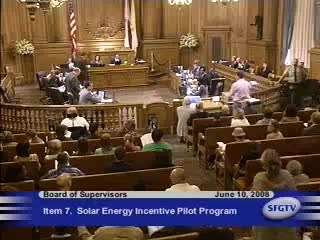
Board approves solar incentive ordinance, adopts companion pilot with low‑income/nonprofit set‑aside
Summary
The Board of Supervisors passed an ordinance creating a solar energy incentive program and adopted a companion pilot program that adds a $1.5 million set‑aside for nonprofits and low‑income housing, while debate focused on scope, funding sources and possible diversion of public‑site investments.
San Francisco supervisors voted to adopt an ordinance establishing a citywide solar energy incentive program and separately approved a pilot program that places a $1.5 million set‑aside for nonprofits and low‑income housing.
Supporters framed the package as a way to expand solar installations, create jobs for local installers and make incentives available to lower‑income households and nonprofit facilities. Michael Bornstein of the Sierra Club told the board he supported both Supervisor Dufty’s ordinance and the amendments developed in Supervisor Ross Mercarimi’s office to “allow a set aside for nonprofits and low income housing.” Julian Davis of San Francisco Tomorrow and representatives of Vote Solar and local solar contractors urged passage as a chance to accelerate renewable infrastructure and workforce opportunities.
Opponents and cautious supervisors warned the programs could divert funds from public‑site projects. Supervisor McGoldrick said she was “shocked” to find $3 million being redirected and urged clarity on whether money earmarked for public solar sites was being repurposed for private property incentives. Other supervisors pressed for measurable goals (megawatt targets) and for better reporting and accountability so the city could track whether funds were achieving broader aggregate energy objectives rather than rewarding early applicants.
An amendment offered by Supervisor Mercarimi clarified the pilot would be additive and complementary to the long‑term program, required additional reporting, imposes workforce requirements and explicitly set aside $1.5 million for nonprofit and low‑income residents. The board adopted the Mercarimi amendment and then approved the pilot.
Votes and next steps: the ordinance adding Chapter 18 to the Environment Code creating the solar energy incentive program (item 5) passed on its final vote; the board adopted the pilot program and Mercarimi’s amendment (items 6 and 7). Supervisors instructed staff and the program administrator to provide the monthly and six‑month reports specified in the legislation so the board can track uptake and equity outcomes.
The board did not adopt numeric citywide megawatt goals in this session; multiple supervisors asked for clearer targets and for reporting that would allow evaluation of whether incentive dollars expand solar access citywide or are concentrated among better‑resourced building owners. The SFPUC, SF Department of the Environment and program administrators were asked to supply updated budget and implementation details in follow‑up reports.