Get Full Government Meeting Transcripts, Videos, & Alerts Forever!
Get email alerts on the Economic Development Films topic
No spam. Unsubscribe anytime.
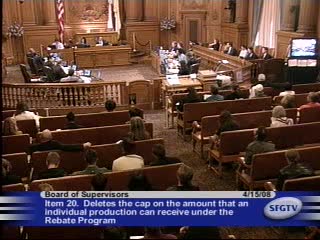
Board advances changes to film production rebate program; ordinance capped individual rebates and survives attempt to rescind
Summary
An ordinance changing the city's film production rebate program to remove a per-production limitation and add a $600,000 per‑production cap passed on first reading. The board later rejected a motion to rescind that first‑reading passage.
The Board of Supervisors advanced an amendment to the city—s film production rebate program on April 15, voting to repeal a provision that linked individual rebates to the amount of tax a production paid and to impose a $600,000 cap per production. The ordinance passed on first reading and a subsequent attempt to rescind that passage failed.
Sponsor and purpose: Supervisor Alioto Pier introduced an "amendment of the whole" that imposes a $600,000 maximum individual rebate per production while leaving the overall program cap of $1.8 million unchanged. The sponsor said the changes are an administrative fix intended to make the program more predictable for producers, to better attract production and to preserve local film jobs without requiring new city funds.
Debate and recusal: Supervisor Ammiano recused himself because of his recent participation in a film production. Opponents on the dais, including Supervisor McGoldrick and Supervisor Peskin, expressed fiscal skepticism. The ordinance passed on first reading by roll call (6 ayes, 4 noes) earlier in the meeting. Later, a motion to rescind that vote failed on a roll call (4 ayes, 6 noes), leaving the ordinance intact on first reading.
Implications: The sponsor and supporters argued the modification targets smaller productions and improves the city's competitiveness in the film industry; supporters cited projected job and spending impacts supplied during committee. Opponents raised concerns about program effectiveness and fiscal priorities during a budget shortfall.