Get Full Government Meeting Transcripts, Videos, & Alerts Forever!
Get email alerts on the Open Government topic
No spam. Unsubscribe anytime.
Board passes first reading of ordinance to require audio/video recording of City Hall hearings after budget debate
Summary
The Board passed on first reading an ordinance requiring audio or video recording of public meetings held in City Hall hearing rooms that have recording equipment. Debate focused on operating costs and funding; a motion to send the measure to the budget committee failed and the ordinance passed first reading 6-5.
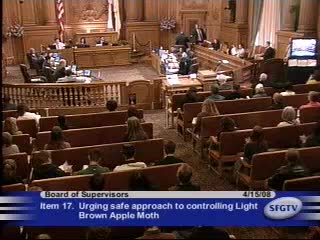
The San Francisco Board of Supervisors passed on first reading an ordinance on April 15 that would require audio or video recording of public meetings held in city hall hearing rooms that are equipped with recording facilities, and to make recordings available on the city's website. The vote on first reading was 6 in favor and 5 opposed.
Fiscal concerns and debate: Supervisor McGoldrick asked whether the ordinance carried a fiscal impact and whether it had been reviewed by the budget analyst or controller. Supervisor Ellsberg moved to send the item back to the budget committee so the board could prioritize it alongside other services during a budget shortfall. That motion to refer failed 5-6.
Ron Vincent of the Department of Technology and Information Services (DTIS) told the board that capital equipment costs — encoding hardware and licensing — could be covered from the cable franchise fund and that ongoing operating cost would involve roughly a half of a full-time equivalent staff member (half FTE) at a total recurring cost in the range of about $76,000 (including fringe) in current dollars. Vincent said the one‑time capital need was about $55,000 and would be funded from cable franchise capital; operating costs beyond the franchise fund would need to be considered in the budget process.
Outcome: The motion to refer to the budget committee failed (5 ayes, 6 noes). The ordinance then passed on first reading by roll call, 6 ayes and 5 noes, and will return for second reading as provided by the city's legislative process.
Implications: Supporters argued recording expands public access to many commissions and panels that are not currently posted online; critics warned the mandate carries ongoing general-fund costs that should be vetted through the budget process and prioritized against other services.