Get Full Government Meeting Transcripts, Videos, & Alerts Forever!
Get email alerts on the Public Health Pesticides topic
No spam. Unsubscribe anytime.
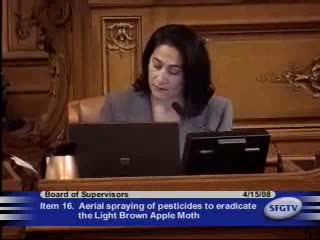
Board of Supervisors unanimously opposes state aerial spraying of light brown apple moth
Summary
The San Francisco Board of Supervisors voted unanimously on April 15 to oppose state plans to aerially spray for the light brown apple moth and urged the state to rely on ground-based, tested approaches and a full environmental and public‑health review before any aerial spraying occurs.
The San Francisco Board of Supervisors voted to oppose aerial spraying of the light brown apple moth and urged the state to use ground-based, tested approaches before any aerial program is implemented. The board adopted two related resolutions — one opposing aerial spraying and another urging the state to rely on ground-based controls and to complete a full environmental and public-health analysis — by unanimous vote.
Supervisors and public commenters said they were concerned the state had not disclosed the precise chemical formula, that human-health studies were lacking, and that the state had not provided a clear spray timetable. Supervisor Mercarini said the city should take "the strongest expression" opposing aerial spraying and added an amendment clarifying that any city-directed legal action would be "subject to the city attorney's current fiscal year budget." That amendment was accepted and the measures were taken up and passed by roll call.
Why it matters: Supervisors described possible health and environmental risks if an aerial program proceeds without a full environmental review. Several supervisors, including Supervisor Sandoval, told the board that experts had testified the pheromone approach is unproven for eradication, that the state had not established a spray schedule or final formula, and that meaningful public disclosure to affected residents had not occurred.
Discussion and votes: Supervisor Sandoval summarized findings from a committee hearing and testified to five conclusions: the product had not previously been sprayed over an urban area; a UC Davis entomologist testified it would manage rather than eradicate the moth; no human-health studies had been presented; the state had not set a time frame for how often it would spray; and the final compound formula had not been settled. Supervisor Mercarini argued that San Francisco should not be treated as "a petri dish" and called aerial spraying "not a sound methodology." Supervisor Dufty and others said a second resolution the board was considering would complement Mercarini's by urging the state to prepare an environmental-impact report and by listing state legislation the board supported.
The board adopted the resolutions as amended by unanimous roll-call votes. Item 16 (resolution opposing aerial spraying) was adopted 11-0. Item 17 (resolution urging use of ground-based methods and urging state environmental review) was adopted 11-0.
What the resolutions call for: The measures (as amended) urge the city attorney to pursue appropriate legal actions to challenge the state's emergency CEQA exemption if needed, ask the state to use maximum feasible ground-based and tested methods, and express San Francisco's support for related state legislation (as identified in the accompanying record).
Context and next steps: Supervisors stressed the measures are intended to send a clear signal to Sacramento and to support pending state bills and legislative efforts. The adopted resolutions also include the city—s request that the state provide fuller disclosure to affected residents before any program proceeds.
Votes at a glance: Item 16 — Resolution opposing aerial spraying: motion by Supervisor Mercarini, second by Supervisor Ammiano; vote 11 ayes, 0 noes; adopted. Item 17 — Resolution urging ground-based approaches and environmental review: adopted 11-0.