Get Full Government Meeting Transcripts, Videos, & Alerts Forever!
Get email alerts on the Solar Incentives topic
No spam. Unsubscribe anytime.
Board amends and advances solar incentive ordinance to create multi-year program and labor-linked rebate
Summary
Boardmembers amended a proposed solar incentive ordinance to require a ten-year planning horizon, add reporting requirements, and tie enhanced rebates to firms that hire graduates of city workforce programs; debate centered on use of MECA funds vs. conservation priorities and on PUC authority.
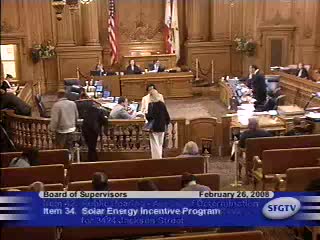
The Board of Supervisors amended and advanced an ordinance proposing a city solar incentive program that would provide rebates for rooftop solar installations and prioritize economic benefits for San Francisco residents.
Assessor-Recorder Cesar Ting's office and mayoral staff presented the plan as a long-term, 10-year incentive program intended to give installers and the local solar industry stable expectations. Under the ordinance as amended, the San Francisco Public Utilities Commission (SFPUC) would administer the program, and a $6,000 incentive payment was proposed for systems installed by teams that include graduates of city workforce-development programs.
The amendments added by the board clarified that an installer's principal office must be located in San Francisco to qualify for certain aspects of the program; required the program administrator to submit an economic and administrative report within 90 days of the end of the first year; and directed that the board review any proposed environmental justice district boundaries and new criteria before future funding decisions.
The board's debate covered when the PUC could implement a rebate program administratively, the relationship between public solar projects and private incentives, and whether MECA (power enterprise net revenues held for energy projects) should prioritize conservation and municipal projects. PUC staff said some MECA funds were available and that the agency planned to issue a power-purchase agreement for several megawatts of large-scale solar projects; planning staff and the controller's office provided context on multi-year appropriations and fund balances.
Amendments were accepted by the board without roll-call objection and the ordinance passed on first reading with the understanding that SFPUC and program staff will report back on administration, budgeting and outcomes.