Get Full Government Meeting Transcripts, Videos, & Alerts Forever!
Get email alerts on the Accessibility Cityhall topic
No spam. Unsubscribe anytime.
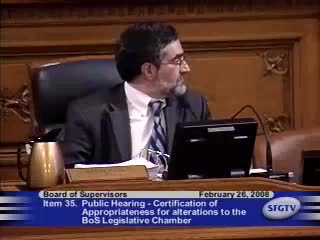
Supervisors approve certificate to make City Hall chambers accessible; debate over cost and timeline continues
Summary
The board heard lengthy presentations and public comment and approved a certificate of appropriateness to modify the president's dais and clerk's desk to make the chambers accessible, while members and public speakers pressed for lower-cost alternatives and clearer relocation plans during construction.
The Board of Supervisors on Tuesday unanimously approved a certificate of appropriateness to make the board chambers in City Hall accessible to people with disabilities after a multi-year design review process, but the item produced extended debate over cost, schedule, and alternatives.
Planning staff and disability advocates presented the chosen design, which retains historic woodwork while adding a gently sloped ramp and lowering the president's dais by 18 inches and the clerk's desk by 6 inches to reach the chamber floor. The Planning Commission and Landmarks Preservation Advisory Board had both voted unanimously to recommend approval.
Susan Misner of the mayor's Office on Disability summarized the multi-year process of refining designs and seeking input from historic-preservation and disability experts. Planning staff explained the design's intent to retain as much historic fabric as possible while meeting accessibility requirements.
Supervisor McGoldrick and others pressed for a clearer budget breakdown and options. Planning staff said approximately $975,000 was appropriated in the 2007-08 budget for the ramp and dais work; audiovisual upgrades and temporary relocation costs for the board during construction were estimated as additional items not covered in that figure. Project managers said the construction window could range from a summer recess timeframe up through roughly the end of the year if audiovisual upgrades are included.
Several members of the public, including architects and preservation specialists, urged the board to seek lower-cost alternatives or further review; others, including Supervisor Alioto-Pier (who uses a wheelchair), stressed that the existing temporary ramp is unsafe and that the chamber should be fully accessible.
—That ramp is absolutely not wheelchair accessible,— Alioto-Pier said, describing the current condition and arguing for completing the permanent upgrade.
The board voted to approve the certificate, with staff noting a requirement to act within statutory deadlines tied to the planning code review process. Officials said they would seek to minimize disruption by scheduling construction to overlap recess periods where possible and to return with further details on relocation options and audiovisual upgrade timing and cost.