Get Full Government Meeting Transcripts, Videos, & Alerts Forever!
Get email alerts on the Pension Retiree Health topic
No spam. Unsubscribe anytime.
Board submits charter amendment on retiree health and miscellaneous retirement benefits to voters
Summary
The Board of Supervisors voted to place a charter amendment on the June ballot seeking to change retiree health funding and improve miscellaneous retirement benefits; supporters said it reduces a long-term liability while opponents pressed for clearer near-term budget numbers.
Supporters of a charter amendment to change the city's approach to retiree health and to improve miscellaneous retirement benefits told the Board of Supervisors on Tuesday that the measure would address a projected multibillion-dollar liability and smooth long-term costs.
Supervisor Sean Ellsburn, the legislation's lead sponsor, told colleagues the measure is intended to tackle what he described as a roughly $4 billion unfunded liability over 30 years and to create a more sustainable approach to retiree health funding and miscellaneous retirement benefits.
—When I first started it, I started looking at one problem — the $4,000,000,000 unfunded liability over the next 30 years,— Ellsburn said. He also credited the retirement board staff and the Department of Human Resources for providing actuarial work supporting the measure.
Budget analyst Ken Bruce told the board the package's projected actuarial cost for the retirement improvements alone is about $84 million annually over 20 years, falling to a much smaller normal cost after that transition period. He said offsets are expected from reduced salary increases treated as permanent in later arbitration/mediation outcomes.
—The actuarial cost of the retirement improvements alone are $84,000,000 annually over 20 years,— Bruce said.
Human Resources Director Pamela Callahan (identified in the meeting as the department director) said the proposal is a compromise that provides long-term fiscal controls while meeting demand for pension improvements among miscellaneous employees. Callahan and Ellsburn both said the precise cross-over point when savings offset the initial cost is difficult to predict but that the measures are intended to produce net savings in the long run.
Several supervisors asked for clearer near-term budgetary numbers. Supervisor McGoldrick pressed staff for what the initial annual hit to the city budget would be and whether it would appear in the 2009-10 budget; Bruce and Callahan said the main budget effects begin in fiscal 2009-10 and that the transition cost estimate is $84 million at that point. Colleagues pressed for detail on how year-by-year costs would change and how salary and bargaining assumptions would affect the projections.
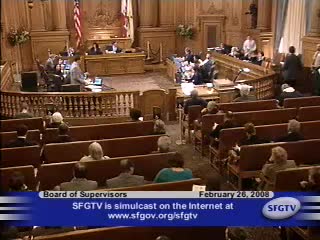
The board voted to submit the charter amendment to the June ballot. The roll call on the measure recorded 10 ayes.
The measure now goes to voters; if approved it will change charter language and set policies the city must follow to fund retiree health and implement the miscellaneous retirement benefit changes. Supporters said it is intended to reduce long-term stress on the general fund; opponents and several supervisors asked staff to return with clearer year-by-year fiscal figures during the budget process so the board can judge midterm effects.