Get Full Government Meeting Transcripts, Videos, & Alerts Forever!
Get email alerts on the Energy Infrastructure topic
No spam. Unsubscribe anytime.
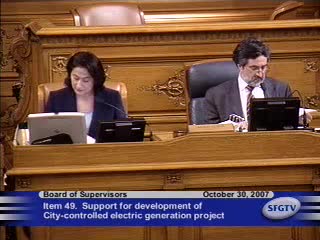
Board approves peaker turbine plan as amended to secure closure of Potrero/Merritt plant
Summary
After hours of debate, the San Francisco Board of Supervisors adopted a resolution supporting construction of four combustion turbine "peaker" units and amendments urging the SFPUC to secure closure of the Potrero (Merritt) power plant and limit peaker operations as renewables come online. The measure passed 8-3 following votes and amendments.
The San Francisco Board of Supervisors voted 8-3 on Oct. 30 to adopt a resolution supporting the construction and description of a transaction to place four combustion turbine (CT) peaker units into operation in the city, a policy the San Francisco Public Utilities Commission (SFPUC) and sponsors said is intended to enable the eventual closure of the aging Potrero (Merritt) power plant.
The board’s action followed several hours of public testimony and member debate on whether the city should site new fossil‑fuel peakers when transmission upgrades and state climate policies are underway. Supervisor Aaron Peskin called the vote after the board adopted two amendments that instruct the SFPUC to (1) secure closure of the Merritt plant as a condition tied to issuance of operating permits for the CTs and (2) require a controlled operating regimen that reduces CT use as city renewable generation becomes available.
The amendments were offered by Supervisor Mark Mercarini and seconded by Supervisor Chris Ammiano and were taken up and approved before the final vote. A separate motion to delay action one week, to await a California Public Utilities Commission (CPUC) meeting, failed on the roll call.
Why it matters: The Potrero/Merritt plant discharges heated cooling water into San Francisco Bay and has been a focus of neighborhood health and environmental concerns. SFPUC staff said the proposed CTs would be much smaller, use recycled cooling water (resulting in no discharge to the bay), and be equipped with contemporary emissions controls. Supporters said the CTs are a practical pathway to ending the plant’s “must‑run” status and cutting local pollution; opponents warned that siting new fossil‑fuel infrastructure risks environmental and public‑health harms and that the city should prioritize renewable alternatives.
What supporters and opponents said
- Supervisor Maxwell, who sponsored the resolution, said closing the polluting units is a top priority and described the CTs as “much smaller, much, much cleaner burning” and designed to run only for reliability emergencies.
- Supervisor Chris Daly said he had earlier supported study work for the peakers but would vote no: “I will be opposing this item… I will be voting no,” Daly said, citing concerns that the Transbay transmission cable and state climate law (AB 32) change the calculus for new fossil‑fuel capacity.
- Barbara Hale, assistant general manager for power at SFPUC, described technical details of the CT design, including air‑cooling using recycled wastewater, selective catalytic reduction (SCR) systems to remove NOx, stacks roughly 85 feet tall (much shorter than the current Merritt stacks), and that the project would eliminate daily discharge of superheated bay water.
Key technical and contractual details discussed
- Project configuration: four natural‑gas peaker units — three sited in the city (near 25 Illinois Street) and one at the airport — intended to be smaller and to operate only when called for reliability.
- Emissions and water: SFPUC staff presented numbers showing substantial reductions in NOx and particulate emissions versus the existing plant and said the CTs would use recycled cooling water with no discharge to San Francisco Bay. Staff said the CTs are roughly 80%+ cleaner on key emissions metrics compared with the existing plant in typical operating scenarios presented to the board.
- Funding and regulatory context: Tony Irons, deputy general manager at SFPUC, said the State Department of Water Resources (DWR) had been funding a $25 million annual capacity fee for the existing facility and had recently sent a termination letter; staff warned that delay could harm the city’s leverage with state agencies. The California Independent System Operator (Cal ISO) and CPUC were repeatedly cited as parties whose reliability requirements shape the outcome.
Board action and next steps
- The board adopted the resolution as amended by an 8-3 vote. The adopted amendments direct the SFPUC to secure Merritt’s closure as a condition related to permitting and to stipulate a controlled operating regimen for the CTs that ramps down reliance on the peakers as renewable capacity and community choice aggregation (CCA) resources come online.
- SFPUC staff told the board the matter will return as a contract for final board approval after any CPUC or related regulatory steps are completed.
Limitations and outstanding questions
- The board debated — but did not finally resolve at this meeting — the detailed contract terms, the exact operating‑hour limits for the CTs, and the effect of imminent or pending state regulatory actions on the Merritt facility. Staff said some negotiation documents had been publicly disclosed and others would be responsive to sunshine requests.
- Several supervisors asked for explicit contractual buyout options and periodic review clauses to allow conversion to renewable fuel or an earlier closure of the CTs if alternatives materialize.
Community and environmental context
The adoption follows years of neighborhood advocacy to shut down the older, high‑polluting units in Bayview‑Hunters Point and Potrero Hill. Supporters framed the CTs as a near‑term step that would materially cut pollution and end thermal discharges to the bay; opponents urged investment in energy efficiency, transmission upgrades, and renewables instead of new fossil‑fuel infrastructure.
Sources: Board debate and staff presentations at the Oct. 30 San Francisco Board of Supervisors meeting.