Get Full Government Meeting Transcripts, Videos, & Alerts Forever!
Get email alerts on the Campaign Finance topic
No spam. Unsubscribe anytime.
Board approves consolidated campaign-finance package, raises supervisors— voluntary spending ceiling and tightens disclosure rules
Summary
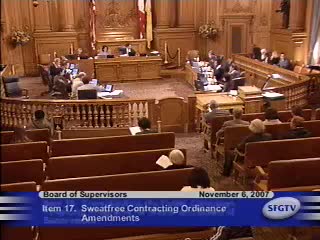
The Board of Supervisors approved a package of campaign-finance measures on Nov. 6, 2007, consolidating mayoral and supervisorial partial public financing, raising the voluntary expenditure ceiling for supervisorial candidates, and adopting new reporting rules for telephonic persuasion polls, circulators and independent mailings.
The San Francisco Board of Supervisors on Nov. 6 approved a set of ordinances that consolidate the city—s partial public financing programs and add new disclosure rules for campaign activity, including telephonic persuasion polls, circulator identification and mass-mailing reporting.
Supervisor Daley introduced the package, saying it would combine the mayor—s and supervisors— partial public financing programs and increase the voluntary expenditure ceiling for supervisorial candidates from $86,000 to $140,000. "It would, I think, strongly encourage candidates to participate," Daley said, arguing the change would reduce the influence of outside big-money spending.
The board also passed ordinances to require callers who conduct or pay for telephonic persuasion "push" polls to disclose information to recipients and file disclosures with the San Francisco Ethics Commission; to require that petition circulators wear badges disclosing whether they are volunteer or paid circulators and to disclose proponents— names on request; and to require persons making independent expenditures to file copies of mass mailings and itemized costs with the Ethics Commission.
Supervisor Ellsberg spoke strongly against the timing and ethics of increasing publicly funded campaign dollars before the next election, saying, "I will be writing Supervisor Daley a thank you letter for the $44,000 contribution to my reelection campaign," and arguing the change should be delayed until the November 2010 races. Supervisor Peskin replied that the measure should be judged on policy merits, not timing.
After debate and amendments recommended by the Ethics Commission (including adjustments to qualifying thresholds and reporting triggers), the board approved the consolidation and ceiling increase on first reading. The votes on the related items were recorded as follows: the consolidation and ceiling increase passed on first reading by roll call (8 ayes, 3 noes); the telephonic persuasion disclosure ordinance passed on first reading (8 ayes, 3 noes); the circulator identification ordinance passed on first reading (10 ayes, 1 no); and the independent-expenditure mass-mailing reporting ordinance passed on first reading (11 ayes).
Why it matters: The package alters the rules governing how candidates for mayor and the board of supervisors finance campaigns and how outside campaign activity is reported and counted against voluntary spending limits. Supporters said the changes close loopholes that allowed unreported or late spending to undermine the partial public-financing system; opponents argued the city should not expand public campaign funding immediately because current members might directly benefit.
The ordinances were taken up as a group with separate votes on each measure. Several technical amendments recommended by the Ethics Commission were folded into the supervisors— measure at the board meeting.
Next steps: The measures were passed on first reading and will return for further consideration as required by the city's ordinance process.