Get Full Government Meeting Transcripts, Videos, & Alerts Forever!
Get email alerts on the Medical Cannabis Dispensary Permits topic
No spam. Unsubscribe anytime.
Supervisors continue medical cannabis dispensary rules after disability-access and delivery-service amendments
Summary
The Board of Supervisors continued an ordinance to revise medical cannabis dispensary rules after adopting a disability-access amendment and agreeing to further review language about which service areas must be accessible and whether delivery-only services should be exempt.
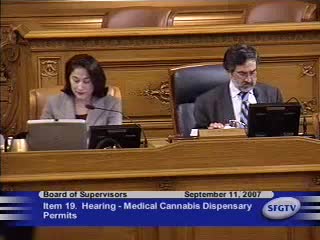
The Board of Supervisors on Tuesday continued consideration of an ordinance that would amend the San Francisco Health Code and Planning Code to regulate medical cannabis dispensaries after the board adopted a disability-access amendment and set additional language for further review.
The measure, brought as Item 20 on the agenda, would require dispensaries to meet new permitting, security and accessibility standards and would extend the deadline for dispensaries to obtain a medical cannabis permit to March 1, 2008. The board accepted an amendment to require indoor bathrooms be accessible except where the Access Appeals Commission grants an unreasonable hardship, then agreed to continue the item for one week so members and affected parties could review text that narrows which parts of a dispensary must be accessible and a separate proposal to exempt delivery-only operations from some permit requirements.
The short-term change adopted by motion would delete the phrase “to the public” from a requirement that bathrooms be accessible and replace it with “except where the Access Appeals Commission grants an unreasonable hardship.” Deputy City Attorney Adams told the board that prior draft language would have required all service areas to be accessible; the narrower phrasing that had been inserted earlier—“any ground floor service area must be accessible”—would limit the requirement to first-floor service areas and was raised as a separate concern.
Susan Misner of the Mayor’s Office on Disability told the supervisors her office would recommend that a hardship be granted only where a bathroom or facility is nonetheless usable (through “equivalent facilitation”) and that, where it is not, the office would not recommend a hardship and would forward the matter to the Department of Building Inspection for resolution. Misner also warned that the Americans with Disabilities Act could require improvements in more cases than city law alone might indicate, because the ADA’s “readily achievable” financial evaluation can result in accessibility being required if a business can afford modifications.
The board heard about three competing areas of concern during the hearing: (1) whether the phrase “any ground floor service area” would limit access only to first-floor spaces, thereby excluding upper-level smoking rooms or dispensing areas; (2) whether bathrooms should be required to be accessible to employees as well as to the public; and (3) whether delivery-only operations should be treated differently from storefront dispensaries.
Supervisor Daley moved the change to delete “to the public” and substitute the Access Appeals Commission exception; Supervisor Ammiano seconded and the board accepted that amendment without a formal roll-call when it was presented as a cleanup item. Supervisor McGoldrick introduced separate language to exempt dispensaries that distribute solely by delivery from some permit requirements; he and supporters said the exemption would recognize small delivery collectives that operate without storefronts. That proposal drew repeated opposition during public comment from patients and disability advocates who said exempting delivery-only operations would deny disabled people access to employment and community participation in the cannabis economy. Several patient advocates and representatives of disability groups urged the board to keep delivery services subject to the same minimum accessibility requirements or to require equivalent facilitation.
More than two dozen members of the public testified during a long public-comment period. Patient advocates including Mira Ingram and David Cohen urged the board to preserve access for disabled workers, saying dispensing services and delivery both serve severely ill people who need reliable, quality medication. Kevin Reed, who operates the Green Cross medical cannabis delivery service, said small delivery collectives have already been through planning channels and that delivery fills an important gap for patients who cannot visit storefronts. Other speakers from the sector—including representatives of the Compassionate Trade Association and Green Apple Books and neighborhood merchants—testified both for and against specific pieces of the proposal.
Because several substantial changes were still under discussion, and after the board accepted several technical clean-up amendments and CEQA findings offered by the city attorney, supervisors agreed to continue the ordinance for one week. The board asked the planning department, the Mayor’s Office on Disability and the city attorney to work with stakeholders in the interim on the wording regarding “ground floor service area” and on clarifying standards for delivery-only dispensaries. The item was left “twice amended” and continued so the board can consider any additional wording changes the following week.
The continuation preserves the board’s other temporary changes, including the longer permit deadline to March 1, 2008, that were already inserted on the record, and gives the city time to reconcile the local code language with state ADA and building-code requirements as the Mayor’s Office on Disability recommended.
Ending: The board did not adopt final legislation Tuesday; members instead approved a disability-access amendment, adopted CEQA and cleanup language and continued the ordinance one week for final wording on whether accessibility obligations apply to all floors and whether delivery-only operations will be treated differently. The city attorney and planning staff will work with disability advocates and dispensary operators before the board reconvenes the item.