Get Full Government Meeting Transcripts, Videos, & Alerts Forever!
Get email alerts on the Transportation Mta topic
No spam. Unsubscribe anytime.
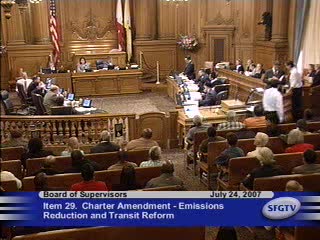
Supervisors advance major Muni charter amendment after hours of debate; vote to solicit public comment next week
Summary
The San Francisco Board of Supervisors adopted an amendment of the whole to a proposed charter amendment that would shift several authorities and new funding rules to the Municipal Transportation Agency (MTA), then voted to send the measure to a Committee of the Whole for public comment and final action next week.
The San Francisco Board of Supervisors adopted an amendment of the whole to a proposed charter amendment that would shift several authorities and a new funding stream to the Municipal Transportation Agency (MTA), then voted to send the measure to a Committee of the Whole for public comment and final action next week.
The amendment, put forward by Supervisor Peskin, won board approval on July 24 after several hours of debate and multiple failed motions to remove or scale back provisions that transfer rate-setting and parking authorities to the MTA commission, expand the agency's contracting and debt powers, and change certain budget processes.
Why this matters: If approved by voters later this year, the measure would change how fares, parking rates and related fees are set, alter the MTA's contracting thresholds, dedicate a larger share of parking-related revenues to the agency, and give the agency increased authority to incur debt tied to its revenue streams. Supporters say the changes provide tools and funding to improve transit; critics say they reduce the board's direct oversight.
What the board did
Supervisor Peskin, the measure's lead sponsor, described weeks of negotiation with labor and city offices and said the package is intended to give the MTA "the tools" and funds needed after years of underfunding. "I am proud to say that yesterday, we concluded a set of very fruitful, negotiations and discussions," Peskin said during opening remarks.
Supervisor McGoldrick and other members pressed for retaining more authority with the elected board. McGoldrick said members were being asked "to essentially abdicate or relinquish a great deal of the authority the board of supervisors lost a lot of that authority 7 years ago," and repeatedly moved to excise or limit language he said shifted power to appointed bodies.
Key provisions discussed
- Rates and fees: The amendment would give the MTA authority to adopt rates, fares and certain parking charges that are now addressed by the board of supervisors. Supporters said the shift would allow integrated transportation policy; opponents said it transfers significant policy decisions away from elected officials.
- Parking revenue: The charter language would increase the share of parking-related funds dedicated to the MTA. Deputy City Attorney Julia Friedlander said the final language increases the amount dedicated to the MTA from 40% to 80% (language in the draft ties the set-aside to an accounting measure based on parking tax receipts).
- Contracting and procurement thresholds: The MTA commission would be able to set internal contracting threshold amounts for staff approvals; however, Friedlander and other city attorneys said contracts above certain Charter thresholds (for example, those covered by Charter Section 9.118) would still require board review.
- Debt authority: The amendment clarifies that the agency may incur revenue-backed debt for agency purposes without voter approval, subject to controller certification that dedicated revenue will cover debt service (deputy attorneys likened this to existing authority available to other city entities with dedicated revenue).
- Referenda and board oversight: The measure preserves the public's right to petition for referendum on MTA board actions, and allows the Board of Supervisors to reconsider or repeal MTA actions if a referendum qualifies.
Amendments offered and votes
Several supervisors proposed piecemeal deletions or modifications before the board adopted the amendment of the whole. Notable moves and outcomes included:
- A motion by Supervisor McGoldrick to delete language on page 8 that would add "rates for off-street and on-street parking, fines, penalties" to the MTA's exclusive authority failed (5 ayes, 6 noes).
- A subsequent McGoldrick motion to remove an extended subsection granting the MTA authority over parking meter zones and parking privileges also failed (5 ayes, 6 noes).
- McGoldrick's proposal to reduce the supermajority threshold for the board to reject the MTA budget from 7 of 11 to 6 of 11 failed (4 ayes, 7 noes).
- A proposal to remove language that would preserve the board's ability to limit parking maximums (a provision later referenced as page 33, subsection 10.b) initially failed, but a later roll call to include that page in the charter amendment passed (8 ayes, 3 noes).
Final procedural actions and tallies
- The board approved the amendment of the whole (as presented on the floor, excluding page 33) by a 7–4 vote.
- The board later voted 8–3 to include the parking-maximum provision that had been debated separately (page 33, subsection 10.b in the draft).
- The board then voted 9–2 to continue the item for a Committee of the Whole hearing next week so the public may comment on the specific amendments adopted; the chair set that session for one week from the meeting date.
Legal and administrative clarifications
City attorneys and deputies answered multiple members' questions during debate. Julia Friedlander, deputy city attorney, said the paragraph authorizing broader distribution arrangements for transit fare media (for example, FastPasses or TransLink) was intended to ease small-scale distribution arrangements and "is not targeted at very large contracts; this is precisely trying to relieve the agency of burdens with respect to much smaller contracts." She also repeated that major contracts and long-term revenue agreements would remain subject to existing Charter limits such as Section 9.118.
Context and reactions
Supporters argued the package is the result of labor and mayoral negotiations and is designed to provide predictable funding and tools to implement the Transit Effectiveness Project and other reforms. "There are 700,000 people who use Muni every day," Peskin said; "having it be a reliable form of transportation is, I think, of the utmost importance to rich and poor alike."
Opponents, led by McGoldrick, said the board was ceding too much of its authority and accountability to appointed bodies, and he repeatedly proposed narrower language or higher board retention of power. Several supervisors said parts of the amendment required further refinement before sending to voters.
What comes next
The board's adoption of the amendment of the whole and the inclusion of the contested parking provision set the draft language the city will review at a Committee of the Whole hearing next week; the board limited further changes because of charter-amendment filing deadlines. That session will include public comment on the changes adopted July 24; the board will return for an up-or-down vote after the Committee of the Whole hearing.
Sources: Board debate and roll-call votes, July 24, 2007 (San Francisco Board of Supervisors).