Get Full Government Meeting Transcripts, Videos, & Alerts Forever!
Get email alerts on the Environment Public Health topic
No spam. Unsubscribe anytime.
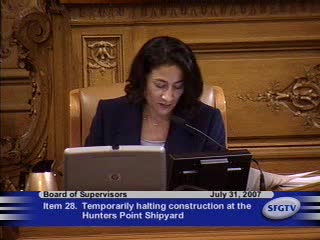
Board declines to halt Hunters Point construction after hours-long health hearing
Summary
After hours of public testimony and a large turnout from Bayview Hunters Point residents, the Board of Supervisors voted down a resolution urging the Department of Public Health and Lennar Corporation to temporarily stop work at the Hunters Point Shipyard and contract an independent health assessment.
After several hours of public testimony on fumes, dust and alleged health effects from work at the Hunters Point Shipyard, the San Francisco Board of Supervisors voted down a resolution urging the Department of Public Health and Lennar Corporation to temporarily halt construction and hire an independent health assessor.
The resolution, introduced by Supervisor Daley, asked the city health department and the developer to arrange an independent epidemiological and medical assessment and to pause grading and other construction activities at Parcel A while that work proceeded. Supporters came from across Bayview Hunters Point — clergy, community organizers, medical professionals and dozens of residents — who said children and other neighbors had developed new or worsening illnesses since heavy grading began. Resident testimony included accounts of nosebleeds, asthma attacks, headaches and skin rashes. Several residents named recent hospital visits and long-term symptoms they linked to the site’s dust and construction activity.
The resolution’s proponents pointed to monitoring exceedances reported in June and July and urged a precautionary response. Supervisor Daley framed the request as a temporary stop to allow independent medical testing and to preserve public confidence. “We shouldn’t have hearings like those that followed September 11 six years from now,” he said, invoking the need for preventive action.
City health officials and scientists who testified disputed that the monitoring or the site conditions showed a public health emergency requiring a stoppage. Dr. Mitchell Katz, director of the Department of Public Health, described site investigations and monitoring programs the department and state regulators had directed and said the levels found to date had not met the state or federal thresholds that would indicate a health emergency. Katz said asymptomatic short-term exposures can cause irritation in some people but that the agency had not identified evidence that warranted an order to stop work.
Independent and academic scientists who testified — including physicians and environmental researchers — disagreed on elements of the data and called for additional study. Some local scientists advised that no single, conclusive biological test exists that can determine whether a given individual’s condition was caused by a particular exposure at the site, while others warned of possible long-term risks and urged independent epidemiologic review.
Lennar representatives and contractor staff answered procedural and technical questions about monitoring, including how asbestos and particulate samples are collected and the laboratory turnaround times. Lennar said it had upgraded dust suppression measures, added perimeter misting and deployed water trucks and monitoring, and that certain monitors showing elevated readings did not trigger automatic stoppage because of their locations or the way the monitoring network had been configured.
After the testimony, supervisors debated whether the board should direct a temporary stoppage or require the city and Lennar to pursue independent health testing. The board voted 5–6 against Daley’s resolution. Because supporters had urged preservation of jobs for local trainees, several members proposed keeping workers paid during any pause; Supervisor Daley had suggested Lennar or the city should ensure continued pay if work were stopped. That amendment did not reach a successful vote. The board did ask staff to continue working with community groups and regulators on monitoring, and several supervisors said they wanted a way to create greater transparency and community confidence in monitoring results and communication.
The vote leaves the site active under the existing regulatory framework. Several supervisors said they would continue to press for more monitoring, clearer public reporting, and stronger community engagement on safety procedures and follow-up health resources for residents who say they are affected.
The hearing featured dozens of residents and local leaders who asked the board for a formal, independent health assessment. Many speakers said they were not seeking to halt the job opportunities produced by the project but wanted rigorous testing and protections before work proceeded further.
The meeting record shows extended questioning of public health staff about monitoring methods, sampling protocols, and the ability to reach definitive medical conclusions about population-level exposures. Officials said the department would continue door‑to‑door outreach and medical services for residents who believe they were exposed. The city and developer said they would continue to improve dust-suppression measures and maintain daily monitoring.
The item remains on the board’s docket for follow-up. Supervisor Daley said he would keep pushing for a more independent review and better communication with residents about monitoring results and health services.