Get Full Government Meeting Transcripts, Videos, & Alerts Forever!
Get email alerts on the Medical Cannabis topic
No spam. Unsubscribe anytime.
Patients and operators urge supervisors to adopt nonbinding compassionate-services resolution and ease local permit rules for medical cannabis
Summary
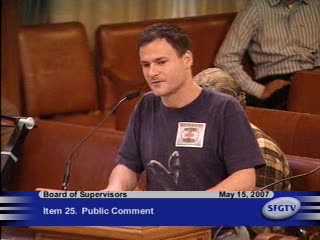
During an extended public-comment period at the San Francisco Board of Supervisors meeting on May 15, patients, advocates and dispensary operators urged the board to adopt a nonbinding compassionate-services resolution, treat state medical-cannabis ID cards as voluntary and remove police sign-off from the local permitting process.
Multiple patients, dispensary operators and advocates used the public-comment period at the May 15 San Francisco Board of Supervisors meeting to press the board for changes to the citys medical cannabis (MCD) permitting policy and to urge adoption of a nonbinding compassionate-services resolution.
Speakers representing collectives, patient-advocacy groups and individual patients described several recurring concerns: that the state-issued medical-cannabis identification card is voluntary under state law and should not be mandatory for local access; that many patients fear registering because of possible federal or employment consequences; that police sign-off in the city permit process has been a barrier for at least one collective; and that the city should formally encourage "compassionate services" programs to make medicine affordable for low- and no-income patients.
Operators and advocates outlined practical alternatives and made specific requests. The operator Marv Walpa told the board the state card is voluntary and proposed that dispensaries be allowed to verify physician recommendations by telephone for patients who do not hold state cards. Walpa said he estimated roughly 70 percent of dispensary patients would fall into the category of not holding a state card.
Representatives of collectives, including the San Francisco Patients Cooperative and HopeNet, described long-standing local compassionate programs and urged the board to adopt a nonbinding resolution to protect and encourage similar programs citywide. "The compassionate service be something that is not going to impact the neighborhood," said Reverend Randolyn Webster, urging that programs be designed so as not to cause neighborhood disruption.
Kathy Smith, proprietor of HopeNet, said the police department had told her it would not sign off on the collectives permit and asked the board to remove police sign-off from the local permitting requirement so collectives can complete the local process. Other speakers called for confidentiality protections for patients and for local processes that would not force patients to obtain a state card if they fear reprisal.
Several speakers described cost and access problems. One speaker, Gilbert, who identified himself as a disabled veteran, told the board medical cannabis can be prohibitively expensive for people on fixed incomes; another commenter urged that compassionate services protect patients from federal enforcement by documenting internal policies.
No formal board action on MCD permitting or the nonbinding compassionate-services resolution was recorded during the meeting; the discussion appeared during public comment and in sponsor-introduced items related to permitting. Advocates said they will continue to press the board and relevant departments for regulatory changes and for adoption of a local, nonbinding resolution supporting compassionate services for low-income patients.