Get Full Government Meeting Transcripts, Videos, & Alerts Forever!
Get email alerts on the Redevelopment topic
No spam. Unsubscribe anytime.
Board endorses conceptual framework for Candlestick Point and Hunters Point redevelopment; calls for community monitoring of contamination risks
Summary
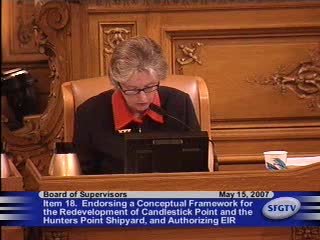
The San Francisco Board of Supervisors on May 15 adopted a resolution endorsing a conceptual framework for redeveloping Candlestick Point and the Hunters Point Shipyard, approving a two-year planning process that could include mixed-use housing, parks and a possible stadium.
The San Francisco Board of Supervisors on May 15 adopted a resolution endorsing a conceptual framework for the redevelopment of Candlestick Point and the Hunters Point Shipyard, approving further planning work that could include mixed-use housing, parks, jobs and — optionally — a new stadium for the San Francisco 49ers.
The resolution, introduced by Supervisor Maxwell and described to the board as a two-year planning framework, passed after debate, 9 to 2. Supporters said the framework prioritizes public benefits for the Bayview-Hunters Point community; opponents warned the plan is too broad and raised questions about oversight and environmental safety.
The framework’s backers told the board the plan has been presented in multiple community meetings and incorporates community feedback. "This framework includes mixed use development that will provide affordable housing, parks, open space, jobs, and other public benefits," Supervisor Maxwell said during her remarks. She also said developers and planners have met with community groups and that about 25 community meetings had been held.
Opponents and several supervisors pressed for stronger safeguards after Supervisor Sandoval described a committee briefing in which air-pollutant monitors at the shipyard had failed for months. Sandoval said the site contains naturally occurring asbestos that can be released during grading and that the community lost confidence when monitors stopped operating. "If this project is going to be successful over the long term, we absolutely have to have the trust of the community," Sandoval said. She urged a mechanism that would allow community-led monitoring, paid for by project sponsors if necessary.
Supervisor Ju said he would not support the resolution because of its scope and fiscal consequences, and because a petition to put the plan on the ballot is being litigated in court. He objected to language in the resolution that ratified actions taken by city staff consistent with the intent of the resolution, calling that provision too broad. Deputy City Attorney Cheryl Adams told the board the ratification language is standard in items of this type.
Supervisor Mercarini urged a parallel discussion about the governance of the Redevelopment Agency, saying that broader structural changes might be the correct response to long-running concerns about redevelopment oversight.
After discussion the board took a roll call vote. The clerk recorded nine ayes and two noes; the resolution was adopted.
The resolution endorses continuing the planning process over roughly two years and directs city staff to pursue the framework with additional community engagement and technical study. Supporters said the next steps include further environmental review and continued community meetings; opponents said the board should maintain tight oversight at each stage.
Clarifying details cited during discussion included that approximately 25 community meetings had already been held, the sponsor asked for a two-year planning process, and that the framework explicitly includes the possibility of a stadium for the San Francisco 49ers but frames public benefits (affordable housing, parks, jobs) as primary. Supervisor Sandoval identified a specific environmental concern: monitors for airborne pollutants at the shipyard had not been operating for a period of months prior to committee review, and the site contains naturally occurring asbestos that could be disturbed during grading.
What’s next: the mayor’s office and the redevelopment agency were asked to continue outreach and technical studies; the resolution does not enact specific land-use approvals but endorses a planning process that will include further analysis and public hearings.