Get Full Government Meeting Transcripts, Videos, & Alerts Forever!
Get email alerts on the Affordable Housing topic
No spam. Unsubscribe anytime.
Board approves $28 million housing supplemental after debate; separate $5 million down‑payment item set aside
Summary
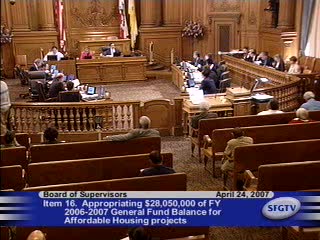
The San Francisco Board of Supervisors approved a $28,050,000 supplemental appropriation for affordable housing programs on April 24, 2007, by a 7–4 vote, after rejecting an amendment to reallocate $5,000,000 to the city’s down‑payment assistance program and voting to create a separate $5,000,000 down‑payment assistance item to be heard next week.
The San Francisco Board of Supervisors approved a $28,050,000 supplemental appropriation for affordable housing programs on April 24, 2007, voting 7 ayes and 4 noes.
The supplemental was debated at length. Supporters said the money targets families and populations least able to afford housing and will be used for a mix of construction, rehabilitation, tenant services and homeowner assistance. Opponents criticized the timing and said the appropriation should be handled through the regular budget process.
Supervisor Daley, the item’s sponsor, described the measure as a targeted response to the city’s affordable‑housing shortfall. “This supplemental does go a step forward,” Daley said, noting the package included funding for families up to 60% of the city median and set-asides for extremely low‑income households and supportive housing for the formerly homeless. Daley told colleagues the city already had stronger than–anticipated revenue and argued the funding would be used to deliver units and supportive services.
Supervisor Sandoval moved an amendment to reallocate $5,000,000 of the $20,000,000 set for acquisition/construction/rehabilitation to the city’s Down‑Payment Assistance Loan Program (DELP/DALP). Sandoval framed the change as a fairness measure to expand homeownership opportunities across neighborhoods and explained how the DELP program works, including that loans are typically repaid on resale and carry no interest. The motion to reallocate was seconded by Supervisor Ellsberg. After roll call the amendment failed, 3 ayes to 8 noes.
Following that vote, the board adopted the original supplemental appropriation as presented by a vote of 7 ayes and 4 noes. Separately, supervisors then moved to divide the file so that a standalone $5,000,000 supplemental appropriation for down‑payment assistance would be prepared and heard next week as a Committee of the Whole item; that divided‑file motion passed by a 7–4 vote. Supervisor Sandoval made the motion to refer the divided item to a Committee of the Whole and Supervisor Ammiano seconded; the referral was approved without objection for scheduling.
Supporters said the supplemental will fund multiple programs: acquisition and new construction, preservation of tenant units, targeted set‑asides for households at 30% of area median income, senior and disability housing, and funding for formerly homeless households and tenant services. Several supervisors described the request as a one‑time opportunity to allocate surplus revenue toward housing needs; opponents repeatedly urged waiting for the regular budget process and for additional analysis from the budget analyst’s office.
Votes at key points: the Sandoval amendment to reallocate $5,000,000 failed (3–8). The main $28,050,000 supplemental passed (7–4). The motion to divide the file and create a separate $5,000,000 down‑payment assistance appropriation passed (7–4) and was set for a Committee of the Whole next week.
The board’s action moves the $28,050,000 supplemental off reserve into a designated housing reserve pending programmatic hearings and required programming by the mayor’s Office of Housing for project selection and implementation.
Details and next steps: the divided down‑payment assistance item will be calendared as a standalone $5,000,000 supplemental appropriation and will require a subsequent hearing to program funds and set distribution rules. The main supplemental will proceed to the mayor for final action according to the city’s normal supplemental appropriation process.