Get Full Government Meeting Transcripts, Videos, & Alerts Forever!
Get email alerts on the Energy Policy topic
No spam. Unsubscribe anytime.
Supervisors introduce community choice aggregation package to expand renewable energy options
Summary
Supervisors Mercarimi and Ammiano introduced a legislative package on community choice aggregation to enable San Francisco to pursue renewable energy procurement and more local control over power sourcing; the topic drew substantial public support at the meeting.
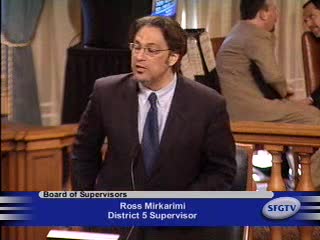
Supervisors Gerardo Mercarimi and Chris Ammiano (as recorded) introduced a legislative package on April 17 to advance community choice aggregation (CCA) for San Francisco, a policy enabling the city to aggregate electricity demand and procure alternative, renewable sources for ratepayers.
In floor remarks, Supervisor Mercarimi framed CCA as a step toward “energy independence” and reducing greenhouse-gas emissions by shifting procurement toward solar, wind and other renewables rather than relying on fossil fuels. Supervisor Ammiano described a long history of advocacy dating back to a 1999 resolution and the later state-level work that enabled local community choice efforts; he called the measure “a revolutionary attempt to minimize global warming” and said CCA would allow the city to procure renewables without municipalization.
Public commenters and local advocates urged rapid adoption. Speakers from the Sierra Club, Greenpeace and community groups called the legislation a necessary step to reduce carbon emissions and criticized token private-sector solar initiatives. One public commenter summarized outreach results from petitioning residents and told the board that San Franciscans were broadly supportive of CCA.
The package was introduced and will be scheduled for committee hearings; no final vote occurred on April 17. The board directed the city attorney to draft implementing legislation and indicated hearings would follow. Public commenters emphasized urgency and urged coordination with the mayor’s office and the state to preserve available funding and avoid replacement of renewable commitments with fossil-fuel purchases.