Get Full Government Meeting Transcripts, Videos, & Alerts Forever!
Get email alerts on the Trinity Plaza Redevelopment topic
No spam. Unsubscribe anytime.
Board advances Trinity Plaza redevelopment package, including replacement units and inclusionary housing
Summary
The Board of Supervisors approved on first reading a set of ordinances and a development agreement enabling the Trinity Plaza redevelopment, including replacement housing for existing residents and new inclusionary affordable units; a separate narrow ordinance on transferable development rights also passed.
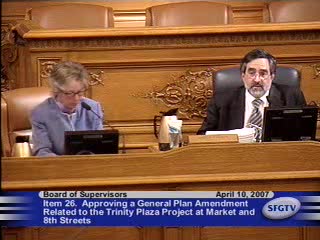
The San Francisco Board of Supervisors on April 10 approved on first reading a legislative package to enable the Trinity Plaza redevelopment, authorizing zoning, a special-use district, a development agreement and changes to the general plan that together clear the way for a multi-building redevelopment near Eighth and Market streets.
Supervisor Daly, who led the item, said the package protects the existing Trinity Plaza tenants and allows Trinity Properties to replace aging units while adding new housing. "When passed, this legislative package will provide the opportunity for Trinity Properties to build ... 360 replacement units," Daly said, and added the package would deliver units under rent-stabilization rules and create more inclusionary affordable housing.
Key points and timeline: Daly told the board the package includes tenant protections, a community room, a children's playground for existing tenants, moving-expense assistance, and the right of current tenants to select new units within the new development. He said Trinity Properties filed a site-permit application the previous day and paid a $186,000 fee to the Department of Building Inspection, which Daly described as evidence of the developer's intent to meet an expedited timeline for Building A; the board record indicates an occupancy timeline for Building A of about 42 months from approval.
Affordable housing: Daly said the package includes replacement units and adds inclusionary units affordable to households at 60 percent of the city's median income; he specified "over 230 units" would be added to the city's inclusionary housing program. The development will also deliver other affordability measures and tenant protections negotiated during committee review.
Votes and next steps: On items 22, 23, 24 and 26 (zoning map amendment, special-use district, development agreement and general-plan amendment) the board recorded unanimous support on first reading; the ordinances passed on first reading. Item 25, a narrowly tailored ordinance on the use of transferable development rights (TDRs) to allow conversion of the Central YMCA building to affordable housing, also passed on first reading. The board referred a separate development-finance resolution and confirmed the package will return for subsequent readings and implementation steps.
Why it matters: The package is intended to replace aging, rent-stabilized housing at Trinity Plaza while preserving the community and adding new affordable units. Supervisors and committee members emphasized a multi-year community effort and detailed negotiations between tenant groups, city staff and the developer.
Ending: The first-reading approvals mark a key procedural milestone for Trinity Plaza; the ordinances and agreements will move forward through required subsequent hearings and implementation steps before construction begins.