Get Full Government Meeting Transcripts, Videos, & Alerts Forever!
Get email alerts on the Public Safety Foot Patrols topic
No spam. Unsubscribe anytime.
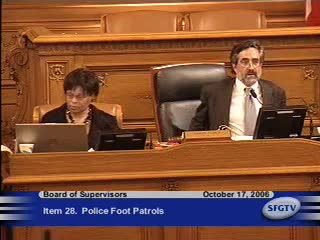
Board advances foot-patrol pilot ordinance after heated debate; amendment to add Central and Richmond sent to committee
Summary
After extended debate, the Board of Supervisors advanced a one-year pilot ordinance directing the San Francisco Police Department to staff foot patrols in several named districts and to report on the program's effectiveness; a motion to expand the pilot to include Central and Richmond stations passed 6–5 and was sent back to committee.
The San Francisco Board of Supervisors on Oct. 17 advanced an ordinance (first reading) to establish a one-year pilot program requiring foot patrols in specified areas of several police districts and to require reporting on the program's effectiveness.
Supervisor Mercarimi, the ordinance's author, said the measure was intended to "systematize" foot patrols and expand a pilot begun in his district so the city could evaluate whether regular, funded foot patrols reduce crime and increase community confidence. "There is a great craving out there to see this kind of practice put into the kind of systemization that I think needs to happen," he said on the floor.
The ordinance names Northern, Park, Tenderloin, Mission, Ingleside, Southern and Bayview police districts for the pilot and requires the police department to report on outcomes at six months and one year. The text also gives the officer in charge discretion to determine specific routes within the geographic boundaries set by the ordinance.
Budget analysts told the board they do not anticipate a direct fiscal impact from the ordinance as drafted, noting added flexibility for police command staffing. Ken Bruce of the Budget Analyst's Office said the department expects no direct new ongoing cost and that civilianization of some positions and upcoming academy classes could provide additional personnel by January. Chief Fong told the board the implementation date was delayed to Jan. 1, 2007, by agreement so newly hired civilian staff and academy graduates would be available and to avoid degrading emergency-response times if officers were reassigned immediately.
Supervisor McGoldrick moved to amend the ordinance to add Central and Richmond stations, effectively expanding the pilot citywide; that amendment passed on a roll call 6–5 and was referred back to committee for further public comment and analysis. The board then proceeded with the original file (unamended) and passed it on first reading by roll call, 8 ayes to 3 noes. The board clerk recorded: "The item passes on first reading."
Opponents raised concerns that the requirement could cause the withdrawal of foot patrols from other neighborhoods or result in staffing strains in large precincts. Supervisor Ellsberg framed the policy question as whether the board should dictate deployment to a paramilitary organization and said captains should retain discretion. Supporters said the ordinance preserves captain-level deployment authority and only establishes minimum coverage and reporting.
The ordinance requires the department to collect and report data on crime incidents and response times; reports were discussed for six-month and one-year review points from the effective date.
— Ending: The board advanced the pilot program measure but split the file: the expanded, amended version including Central and Richmond will return to committee for additional public comment; the original ordinance proceeds on the legislative track for final readings and oversight.