Get Full Government Meeting Transcripts, Videos, & Alerts Forever!
Get email alerts on the Medical Cannabis Regulation topic
No spam. Unsubscribe anytime.
Supervisors advance medical cannabis rules, clarify notification and permit process
Summary
The Board of Supervisors approved amendments on first reading to the city—ode regulating medical cannabis dispensaries, keeping criminal background checks, adjusting notification distances, and creating provisional permits to let property owners learn permit outcomes before major investments.
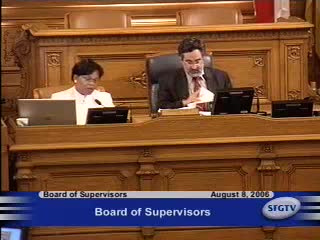
The San Francisco Board of Supervisors on Aug. 8 approved on first reading a set of amendments to the city's medical cannabis dispensary law that clarified notice distances, retained criminal background checks, and created a provisional-permit step intended to reduce financial risk for dispensary applicants.
The ordinance amendments, introduced by Supervisor Mercarini, passed after an amendment of the whole was approved 9-1. Mercarini said the changes respond to interdepartmental feedback after the board—s lengthy original regulation that took effect in January 2006, and to correct what he called "a lot of disinformation that's been put out there." He emphasized: "criminal background checks have been retained," and said the amendments do not reduce public-notification protections.
Why it matters: The ordinance package rewrites portions of the health, planning and building review process for medical cannabis dispensaries (MCDs) to align planning and public-health practices, to set clearer standards for places of assembly and fire-code consistency, and to allow a provisional permit that gives an applicant a formal read on whether a full permit will be granted before they invest in tenant improvements.
Key provisions and debate: Supervisors discussed three substantive areas. First, notification distance: the planning department recommended reducing the notice radius to 150 feet to match Sections 311 and 312 of the planning code; the board—s earlier law had used 300 feet for both property owners and tenants and negotiators sought a balanced approach.
Second, background checks: Mercarini and staff clarified that the police department will continue to conduct criminal-background checks. Several supervisors and staff said the law had earlier—incorrectly, they said—been characterized in public as removing criminal checks or permitting only employment checks; deputy city attorneys and staff corrected that interpretation.
Third, provisional permits: Deputy city attorney Rick Scheinfeld described the provisional-permit mechanism as "designed to avoid the problem—" of owners spending tens of thousands of dollars on tenant improvements only to learn afterward that a permit will not be issued. Scheinfeld summarized: "What the provisional permit provides for is that you find out whether you're going to get your permit before you've put all your money. Everything you're going to have to jump through every hoop to get your provisional permit. You're going to have to get plans approved by building inspectors. You're going to have to... give the public a voice. There will be the criminal background check, all of it." Scheinfeld said the provisional permit does not authorize opening for business; it authorizes construction so applicants can complete work with some certainty that a final permit may follow if inspectors and police sign off.
The amendments also clarify the Department of Building Inspection's role in the interdepartmental permit referrals, make place-of-assembly permit requirements consistent with the California Fire Code, and clarify the term "recreation facility" as programs for people under age 18.
Votes and next steps: The board voted 9-1 to adopt the amendment of the whole and the ordinance passed on its first reading. The board heard a technical amendment from Deputy City Attorney Cheryl Adams to incorporate findings of consistency with the general plan and the planning commission resolution (No. 17103) into the redraft. The ordinance will return for a subsequent reading and final adoption vote.
Process notes and limits: Several supervisors pressed staff about the details of the provisional-permit timeline, in particular when discretionary (public) review occurs and which checks (health, police, building) occur before or after provisional issuance. Staff said discretionary review and public hearings occur before provisional issuance; building-inspection sign-off and police security verification follow construction and become final conditions converting a provisional to a regular permit.
Ending: The board's action preserves criminal-background checks and creates a provisional permit intended to reduce financial risk for would-be dispensary operators while the city completes interdepartmental rulemaking and technical fixes to the original law passed earlier in 2006.