Get Full Government Meeting Transcripts, Videos, & Alerts Forever!
Get email alerts on the Ocii Budget topic
No spam. Unsubscribe anytime.
OCII adopts $622.2 million budget for 2025–26 to fund housing, parks and infrastructure
Summary
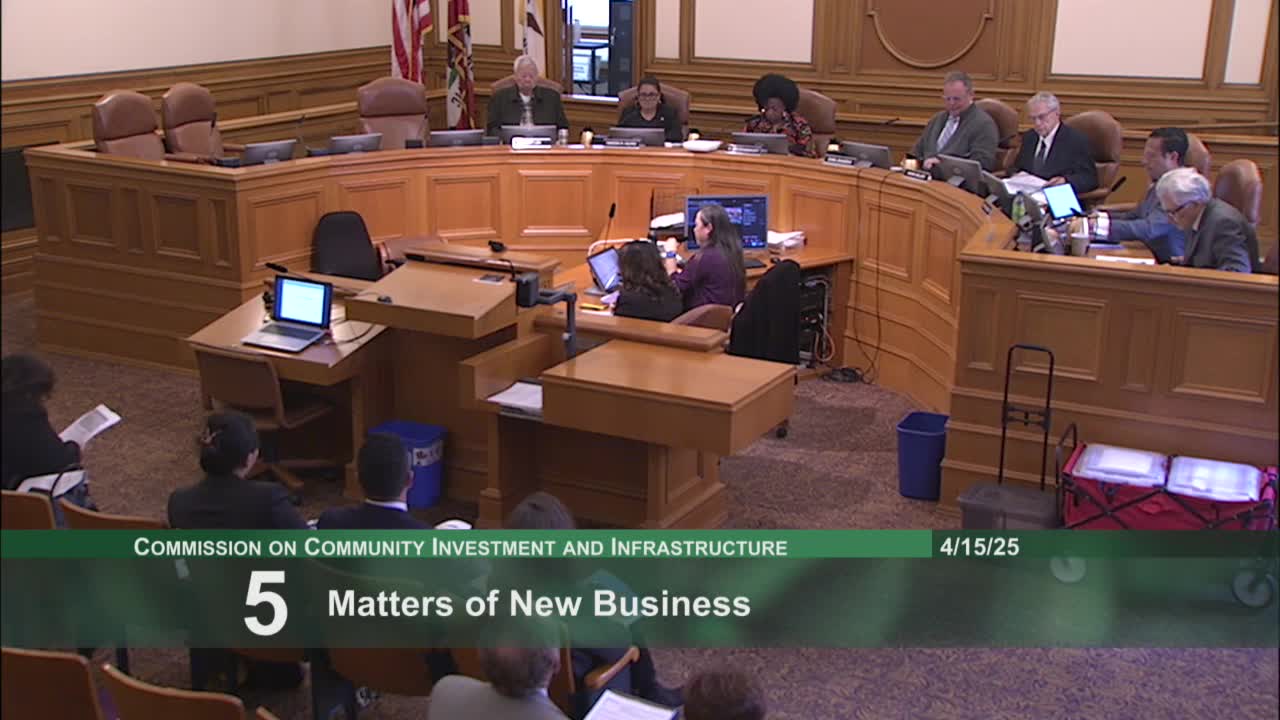
At its April 15 meeting the San Francisco Commission on Community Investment and Infrastructure approved a $622.2 million budget for fiscal year 2025–26 to advance affordable housing, parks and infrastructure across Mission Bay, Transbay and Hunters Point Shipyard/Candlestick project areas.
The Commission on Community Investment and Infrastructure on April 15 approved a $622,200,000 budget for the period July 1, 2025, through June 30, 2026, and authorized the executive director to submit the budget and an interim budget to the mayor's office and the Board of Supervisors.
The budget funds projects across OCII’s three project areas — Mission Bay, Transbay and Hunters Point Shipyard/Candlestick — and carries the successor agency’s remaining enforceable obligations from the former redevelopment agency. “This is our annual budget review … and it presents about $620,000,000 in projects across our three project areas,” Acting Director Mina Yu said during the presentation.
Why it matters: OCII said about half of the budget will fund affordable housing programs, with the remainder covering infrastructure, parks and nonhousing work. The agency plans multiple bond issuances and continued drawdown of prior-period authority that represents multi-year construction budgets and previously issued affordable-housing loans.
Key details - Total budget requested: $622,200,000 for FY 2025–26. Mina Yu told the commission the number reflects the State Department of Finance–approved recognized obligation payment schedule (ROPS). - Major funding sources: prior-period authority (largest), property tax increment, and anticipated bond proceeds. The budget reflects a year-over-year decrease of about $62.9 million driven primarily by timing changes in the affordable-housing project pipeline and continued spending on prior-year projects. - Major uses: roughly 50% for affordable housing; the next largest portions for infrastructure and other nonhousing work. Operations are about 3.2% of the total budget. - Staffing and operating numbers: operating budget about $20,000,000; labor costs about $10,200,000; FTEs remain at 55 (including 17 vacancies). Nonlabor is approximately $5,600,000 and retiree obligations about $4,200,000.
Planned projects and program notes - Mission Bay: complete infrastructure, design two Transbay parks, begin Block 48 horizontal infrastructure; spend down a predevelopment loan for Block 4 East Phase 1 (165 family units) and enter a new predevelopment loan for Phase 2 (235 units). OCII also plans a solicitation for Mission Bay South Block 12 West that could include roughly 243 affordable units. - Transbay: continue construction of Block 3 infrastructure, advance the under-ramp park design and construction preparations, and spend down permanent loans for Block 2 East and Block 2 West (335 units combined). OCII described a $106,000,000 line in the Transbay infrastructure budget that includes bond proceeds and previously issued bonds; OCII does not expect to expend the full sum in FY25–26. - Hunters Point Shipyard and Candlestick Point: focus on predevelopment, finish affordable units under construction in Shipyard Phase 1, continue cleanup coordination with the Navy on parcels still under federal oversight and start horizontal infrastructure work for upcoming Candlestick phases.
Budget process and approvals OCII staff said the oversight board approved the ROPS on January 30 and the Department of Finance approved it April 11 with no changes; the commission vote approves the local budget and authorizes submission to the mayor and Board of Supervisors.
Public comment and equity commitments Community member Oscar James urged the commission to prioritize “hyper local” Black contractors and certificate-of-preference holders for jobs created by the agency’s projects. Commissioners and staff responded during the meeting that OCII is focused on small business enterprise (SBE) and workforce goals and will continue to pursue local hiring and contractor participation measures.
Vote and motion Commissioner Avaish Aracchino moved to approve item 5(a); Commissioner Miller seconded. The roll call vote was 5–0: Commissioner Lim — Yes; Commissioner Miller — Yes; Commissioner Shattuck — Yes; Vice Chair Aquino — Yes; Chair Dr. Carolyn Ransom Scott — Yes. The motion carried.
Looking ahead OCII staff said they will next submit the approved budget to the mayor's office and Board of Supervisors. Bond issuances referenced in the presentation are targeted across calendar 2025–26 and will return to the commission when staff seek authority to commit construction funds.