Get Full Government Meeting Transcripts, Videos, & Alerts Forever!
Get email alerts on the Public Safety Immigration topic
No spam. Unsubscribe anytime.
Winter Springs commission approves memorandum allowing limited participation in ICE 287(g) task force
Summary
The City Commission voted 4-1 to approve a memorandum of agreement that allows designated Winter Springs officers to participate in an ICE 287(g) task-force model. Supporters said the agreement targets criminal offenders with civil immigration warrants; opponents warned it could erode trust with immigrant communities.
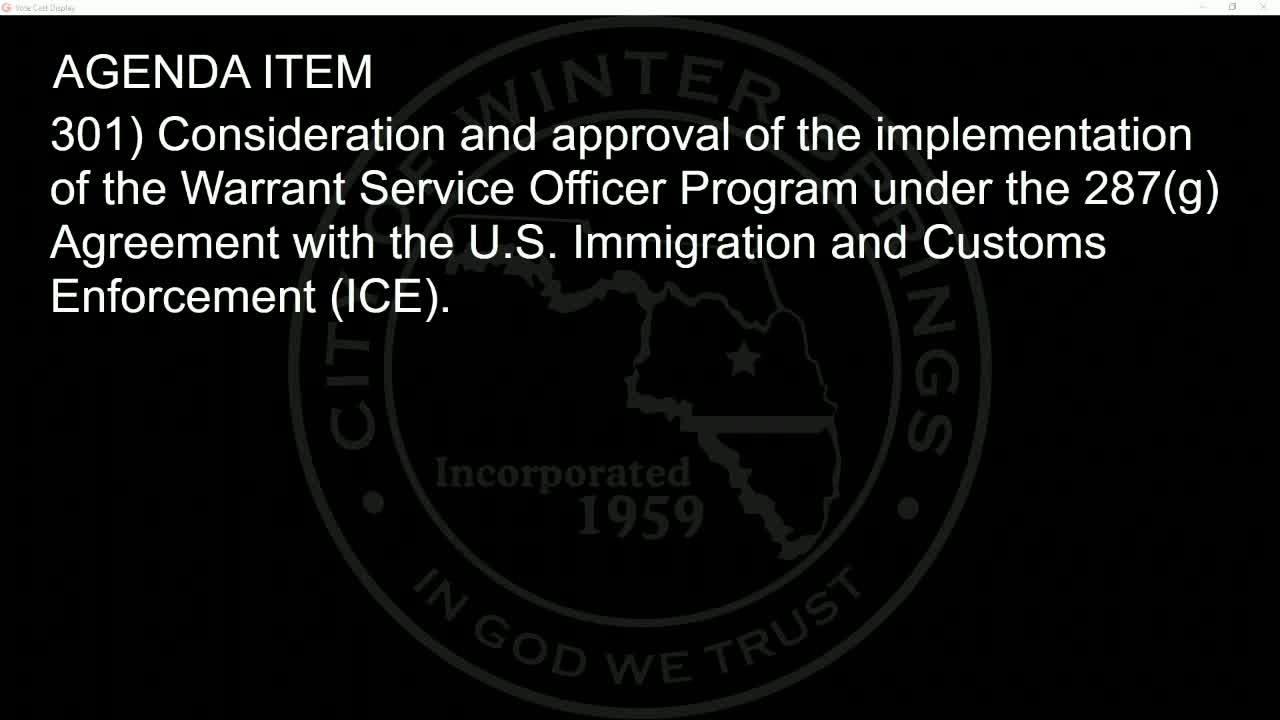
The Winter Springs City Commission approved a memorandum of agreement (MOA) to allow limited participation in a federal ICE 287(g) task-force model, voting 4-1 on consent item 301 after a lengthy council discussion on civil-rights and local control concerns.
Commissioners and members of the public debated whether the task-force model would help the city target violent offenders or open the door to racial profiling and erosion of trust. Police leaders described the program as narrowly focused and optional for officers, while critics cautioned it could have chilling effects on immigrant cooperation with police.
The police chief told the commission the task-force model would allow a small number of specially trained officers to detain people with documented civil ICE warrants and transport them to the county jail when those warrants exist. “This is not a search-and-seek for immigration violations in our city,” the chief said during the discussion. “The intent of this was to target the violent offenders that are here illegally and have already committed crimes that the nation knows about.”
Commissioner Sarah Baker said she had “deep concerns regarding the involvement of our local police department and ICE initiatives that feel politically motivated,” warning the MOA risked “excessive and unnecessary detentions disproportionately affecting people of color.” She asked for details on training, oversight and the program’s differences from normal arrest procedures; the chief and city staff responded that the MOA requires specialized training and that officers would not be asked to conduct immigration enforcement outside of situations involving arrest or existing warrants.
City staff told the commission the operational costs would be minimal and that many other municipalities and the county sheriff’s office had signed similar agreements. Staff also noted the MOA contains an opt-out provision allowing the city to withdraw at a later date.
After discussion, Deputy Mayor Cade Resnick moved to approve the MOA with an updated title reflecting the “task-force model” language; Commissioner Mark Caruso seconded. The motion passed 4-1 (Resnick, Caruso, Diaz and Bruce voting yes; Baker voting no).
The commission’s action directs staff to finalize and transmit the MOA as approved and to provide follow-up materials on training, oversight and the opt-out procedure.
Why it matters: The vote authorizes a formal relationship — limited in scope, according to staff — between Winter Springs law enforcement and a federal immigration enforcement program. Supporters said it helps remove violent offenders; opponents said it risks local trust and could produce unintended civil-rights costs.
What comes next: Staff will finalize the MOA wording (the title was amended during the meeting), transmit the agreement as required, and provide the commission with a summary of training and oversight procedures. The MOA text includes an option for the city to withdraw at a later date.