Get Full Government Meeting Transcripts, Videos, & Alerts Forever!
Get email alerts on the Code Enforcement topic
No spam. Unsubscribe anytime.
Oak Grove council delays ordinance on administrative citations after extensive public debate
Summary
The Oak Grove City Council on April 14 voted 5-0 to table a proposed administrative citation ordinance and a related fee schedule after extended public comment and questions about legal procedure and property rights.
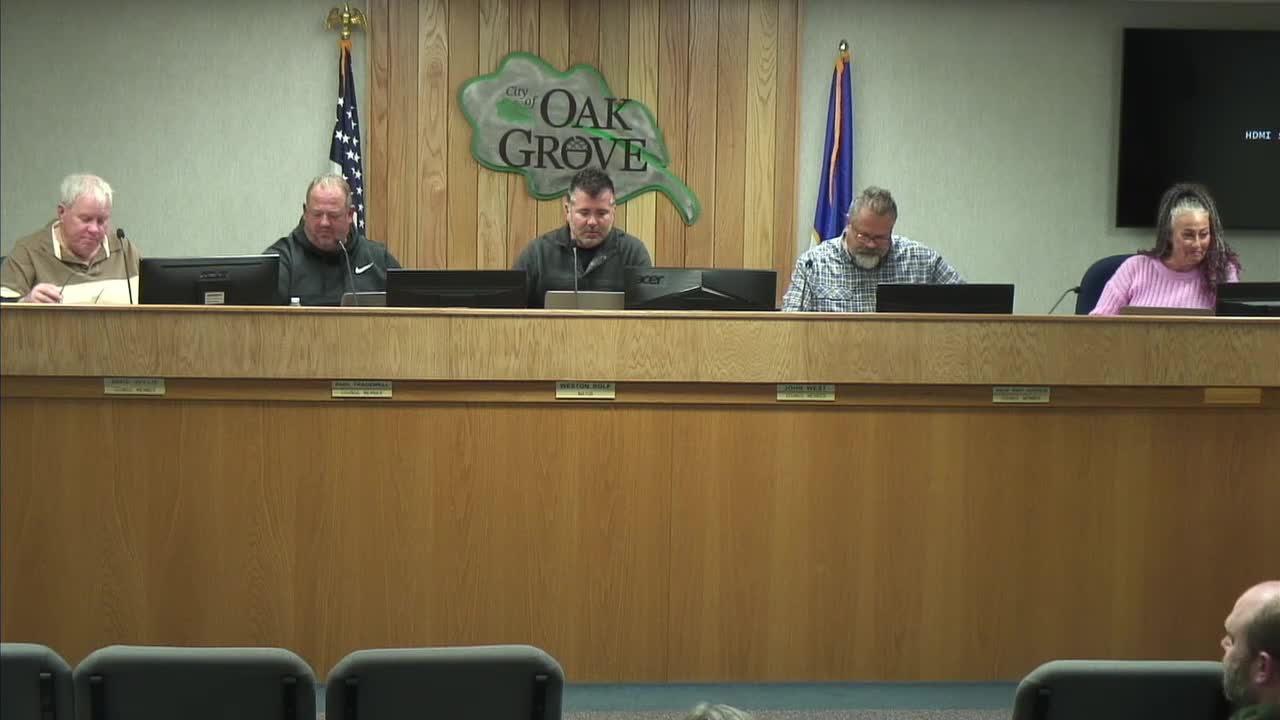
The Oak Grove City Council on April 14 voted 5-0 to table a proposed administrative citation ordinance and a linked fee schedule after extended debate and a large public turnout.
Council members and residents traded concerns about property rights, the limits of local enforcement and whether the city’s current complaint-driven approach is sufficient. Mayor Rolfe told residents the council was seeking a compromise, not an expansion of enforcement powers: “We’re trying to find a way that our residents don't get a criminal record over having a junk car in their yard. We're trying to just get compliance,” he said.
The proposal would authorize administrative fines as an alternative to criminal prosecution for some code violations, a change city staff and the consultant Rum River Consultants (RRC) say could speed enforcement and reduce long court delays and city legal costs. RRC told council it is often slow and costly when the city must pursue criminal charges through Anoka County and the prosecuting attorney, and that an administrative process can provide a faster, escalating remedy.
Nut graf: The council did not reject the policy but delayed action to allow the city attorney to respond to a long list of legal and procedural questions raised at the meeting. Residents argued both for stronger enforcement against persistent property problems and against what they called the risk of government overreach. The council directed staff to place the items on a future agenda when the city attorney can be present to answer legal questions.
What the measure would change - The draft ordinance would create a civil (administrative) citation process with fines for certain code violations, and a fee schedule listing fines for specific offenses. City staff and supporters say the tool is meant to be complaint-driven rather than a basis for proactive “door-to-door” enforcement. - Proponents argued an administrative option reduces repeated legal expenses and long waits for court dates. City staff reported the city currently has about 78 active code-enforcement cases and that 122 cases have been resolved since the city moved to the current complaint process; 18 cases have been referred to the city attorney.
Concerns raised by residents and council members - Several residents described fear of government overreach if a new enforcement tool is created. John Anderson told the council the draft ordinance was “6 pages of unnecessary administrative bloat” and urged the body to “resist the temptation to make our community just like the neighboring communities.” - Others said the criminal route is already ineffective for the most persistent problem properties and that an administrative process could save the city money and produce faster compliance. Planning Commission Chair Brad Johnson said that administrative penalties can keep matters out of the criminal system and that “an escalating financial incentive...seems to be the only way that gets people to actually do something about it.” - Several speakers asked for stronger protections to ensure enforcement remains complaint-driven and not used to harass neighbors. Council member Pam Johnson said she wanted explicit language in the ordinance to confirm a complaint-driven model.
Council action and next steps - Motion: Council Member Wylie moved to table the ordinance (agenda items A and B) and the related fee schedule pending the city attorney’s presence; Council Member West seconded. Outcome: motion passed 5-0 (tabled). - The council likewise tabled the fee schedule associated with the ordinance and asked that questions about administrative procedures and legal authority be addressed by the city attorney when the item returns to a future meeting (the attorney is expected to attend the April 28 meeting).
Why the delay matters The council repeatedly emphasized it is trying to balance property-owner rights against neighbors’ complaints about long-running nuisances. Supporters say civil fines would give staff a faster, more cost-effective tool than repeated criminal prosecutions that can drag on in county court. Opponents warned any new tool could be expanded or abused by future councils.
What was not decided The council did not adopt or reject the ordinance. The vote was procedural: the council chose to pause further action until the city attorney can answer questions about due process, legal thresholds, fee collection and how attorney fees or abatement costs could be recovered.
Clarifying details - Active code enforcement cases reported by staff: 78. - Previously resolved cases reported by staff: 122. - Cases referred to the city attorney (as reported at the meeting): 18. - City approach described at the meeting: complaint-driven enforcement; council members repeatedly said they did not intend proactive “drive-by” enforcement.
Speakers (selected) - Mayor Rolfe — Mayor, government - Council Member Wylie — Council member, government - Council Member Tradewell — Council member, government - Council Member West — Council member, government - Council Member Bray Johnson — Council member, government - Lauren (last name not specified) — City staff member, government (city administrator/staff) - Greg (no last name given) — Rum River Consultants (contracted code-enforcement representative), business - John Anderson — Resident, citizen - Pam Johnson — Resident, citizen - Michael Swise — Resident, citizen - Brad Johnson — Chair, Planning Commission, government - Carl Johnson — Resident, citizen - Nancy Adams — Resident, citizen
Authorities cited (as discussed at the meeting) - Minnesota administrative rule 7080.215 (referenced by staff in relation to septic setbacks) - City ordinances (administrative citation provisions being proposed) — draft ordinance text reviewed by council (referenced but tabled)
Proper names (selected) - Rum River Consultants (organization) - Anoka County (jurisdiction) - Oak Grove (jurisdiction)
Provenance - topicintro: transcript block_id "2839.67" evidence_excerpt "Alright. We are now to old business, ordinance, 20 20 five-two administrative citations." reason_code "topicintro" - topfinish: transcript block_id "5717.81" evidence_excerpt "Motion passes 5 to 0 to table it." reason_code "topicfinish"
Searchable tags: ["code enforcement","administrative citations","Oak Grove","complaint-driven","local government"]