Get Full Government Meeting Transcripts, Videos, & Alerts Forever!
Get email alerts on the Recovery Residences topic
No spam. Unsubscribe anytime.
Committee reviews draft recovery-residence ordinance; law department and staff outline enforcement, certification and privacy questions
Summary
City law staff presented a draft recovery-residence ordinance proposing operator licensing tied to state certification, a zoning-compliance step, civil-enforcement authority and a six-month compliance grace period.
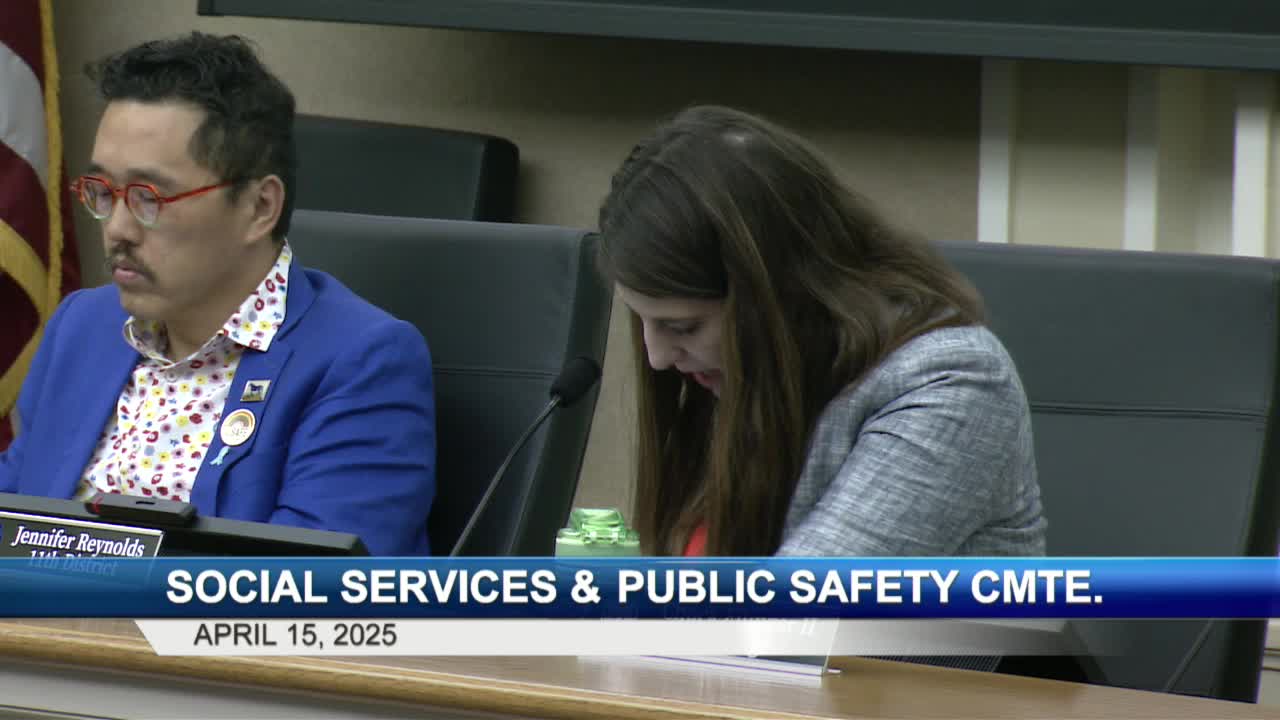
City law department counsel presented a draft recovery-residence (sober-living) ordinance to the Lexington Social Services and Public Safety Committee on April 15, summarizing how the proposal would integrate recent state law, local licensing and federal civil-rights constraints.
Law Department attorney Michael Cravens said the draft follows the state requirement that operators be certified by an approved certifying organization and provide proof of that certification. The ordinance would require operators — not individual tenants — to obtain an annual local recovery-residence license, provide documentation to the city for compliance review, and submit a zoning-compliance permit confirming the use is appropriate for the property’s zoning. Cravens said the draft includes a six‑month grace period after enactment to allow operators time to comply.
Cravens reviewed two federal legal guardrails that shape the draft: the Fair Housing Act and the Americans with Disabilities Act. He said both statutes generally protect people in recovery from discrimination on the basis of disability (with statutory language excluding current illegal use of controlled substances). He cautioned the committee that local rules cannot treat groups of people in recovery less favorably than other protected groups or residential uses, so the draft does not create special land‑use density limits for recovery residences and treats the housing use similarly to student or other shared housing.
Key features Cravens described in the draft ordinance include: - a requirement that operators submit proof of state certification and obtain a renewable local license; - a zoning-compliance permit process, with notice to abutting property owners as part of the permit application (described as a formalization of existing “good neighbor” practices used by some certifying programs); - an enforcement scheme authorizing civil citations and penalties (with a maximum civil penalty in draft language) and an appeals process; and - a provision permitting immediate action by the government if the enforcing division and the law department determine there is a threat to public health, safety or welfare.
Committee members asked detailed questions about how the ordinance would work in practice. Council Member Martin sought clarification on occupancy, and Cravens said the ordinance does not displace generally applicable zoning occupancy limits and that the planning division’s guidance sets a maximum of eight residents per unit for this use. Members asked what precise circumstances would trigger immediate closure; Cravens said action would be considered when there is a documented, immediate threat to public health or safety and that the law department would advise enforcement divisions case by case.
Council Member Lynch and others asked whether the city law department had consulted the Kentucky Alliance of Recovery Residences (KARR, referenced in the meeting as KYAR or Kyar). Cravens said social services staff had been in contact with the state organization; Dane Priest, executive director of the Kentucky Alliance of Recovery Residences, later spoke to the committee and outlined the state certification process, noting it can range from two weeks to more than a year depending on completeness of documentation. Priest said the certification process is a multi‑phase review (registration, policies and procedures, and on‑site verification) and that his organization can notify local municipalities when a certification is revoked or denied.
Council members raised several operational concerns they asked the administration to address before advancing ordinance language: how complaints will be routed and tracked (311 was proposed as a routing mechanism), whether the city will publish locations or only generalized location information because of safety and fair‑housing concerns, how the city will assess and record repeated law‑enforcement or code‑enforcement incidents when considering nonrenewal, and what the city will do for residents displaced if a bad‑actor operator is shut down. Social services staff replied they do not have capacity to rehouse residents but cited an existing Recovery Supportive Living Assistance (RSLA) program that could be used to help some displaced residents and said the city would publicize resources to assist rehousing.
Cravens noted the draft intentionally avoids regulating tenants’ behavior or treating tenants differently from other residential occupants; the draft focuses on operator licensing and certification. Committee members requested that the ordinance clarify definitions (for example, mirroring the state law definition of recovery support services), that standard operating procedures be drafted and published to explain complaint and penalty matrices, and that staff and legal counsel develop concrete re‑housing or transition plans so a closure does not leave residents immediately without options.
Ending: Council Member Morton — sponsor of the item — said the draft is a starting point and pledged continued stakeholder engagement; council members on the committee said they expect additional revisions addressing occupancy, privacy of location information, enforcement thresholds, notification timelines for certification changes, and capacity for post‑closure resident support before the ordinance moves forward.