Get Full Government Meeting Transcripts, Videos, & Alerts Forever!
Get email alerts on the Domestic Violence Services topic
No spam. Unsubscribe anytime.
Fayette County Sheriff outlines Amanda Center services, partnership network for victims of domestic and sexual violence
Summary
Sheriff Kathy Witt told the committee the Fayette County Sheriff’s Office Amanda Center provides 24/7 advocacy, emergency-protective-order support and supplemental services—rideshare credits, security devices and on-site GPS monitoring when ordered by a judge—to survivors of domestic and sexual violence.
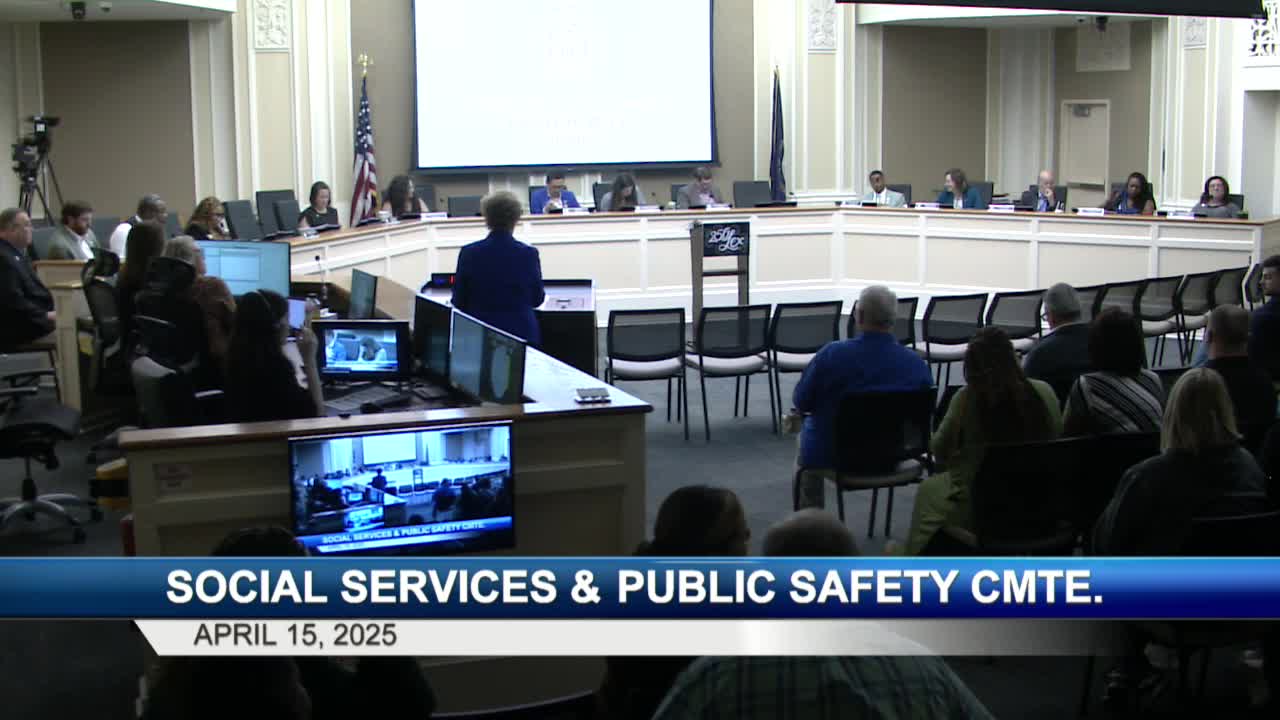
Sheriff Kathy Witt told the Lexington City Social Services and Public Safety Committee on April 15 that the Fayette County Sheriff’s Office operates the Amanda Center, a unit of the sheriff’s office that provides around-the-clock advocacy and support to people seeking protective orders and other services related to domestic and sexual violence.
Witt said the Amanda Center currently has six advocates, four sworn staff and a commander, and that the office uses federal grant funding to cover part of those salaries and to pay for nontraditional supports such as rideshare credit for court appearances, installation of home security devices and a GPS ankle-monitoring capability that can be deployed immediately when a judge orders monitoring under a protective order. “We are open 24/7, 365 days a year,” Witt said. “When you come to the courthouse, you’re going to be met with someone who supports you and who believes you.”
The Amanda Center, Witt said, also enters emergency protective orders and domestic abuse orders into state and national systems so the orders are accessible to law enforcement across the country, and the office manages safe surrender and return of firearms tied to protective orders by conducting background checks, including checks of the federal NICS database.
Witt traced the Amanda Center’s origins to a 2010 naming in memory of Amanda Ross and described the center’s evolution from a small unit created in 1992 into the larger division that works with Lexington Division of Police, the county attorney’s office and other local partners. She described federal funding sources that support the center’s work, specifically Victims of Crime Act (VOCA) and Violence Against Women Act (VAWA) grants, and said some equipment and services—such as phone and doorbell devices—are purchased with those funds.
Council members and other committee members asked how services are provided to people who cannot come to the courthouse and whether supports are available irrespective of gender identity. Witt said staff and cross-deputized personnel can go to hospitals or homes, and she affirmed the office’s policy of serving “everyone who comes into the office of sheriff,” including transgender survivors. Council Member Curtis cited national studies on elevated risks for transgender people; Witt noted the office’s intention to support all survivors and deliver services wherever they are needed.
During public comment and committee discussion, Sheriff Witt and Council Member Gray also described the office’s community outreach: a domestic violence vigil each October at the Fayette District Courthouse plaza, pamphlet distribution at neighborhood meetings and partnerships with local nonprofits. Council Member Gray credited the sheriff’s office with providing a ring doorbell to her after she reported an assault; Gray said the office helped install it.
Later in the meeting Stephanie Thigston, coordinator of the Lexington Domestic and Sexual Violence Prevention Coalition (a city-supported coalition), gave an overview of the coalition’s work. Thigston described programmatic lines including “It’s Time Lexington,” a citywide prevention initiative; a youth prevention and response coordinator (Melissa Wallace) focused on children exposed to violence; and a Green Dot Lexington specialist (Alyssa Turk) who provides free bystander-training for schools and organizations. “Kids are survivors too,” Thigston said, and the coalition is working to expand responses and resources for children.
Thigston reviewed local and national statistics the coalition uses in outreach: she said an estimated one in five women and one in 71 men experience sexual assault in their lifetime and that reporting rates are low — she cited a figure that about 63 percent of sexual assaults are not reported to police. She urged council members to use city platforms to spread awareness and to support inclusive policies and survivor-centered services.
The sheriff’s office and the coalition both invited further input from council members and community partners and offered contact points for people seeking services or wanting to volunteer information or ideas.
Ending: Committee members praised the presentations and thanked staff and community partners. No formal vote or ordinance was taken on the presentations; the session moved next to a separate agenda item about recovery residences.