Get Full Government Meeting Transcripts, Videos, & Alerts Forever!
Get email alerts on the Election Administration topic
No spam. Unsubscribe anytime.
Harrisonburg election official sets training, canvass and provisional-hearing times ahead of June primary
Summary
City elections director Mark Banks told the Harrisonburg City Electoral Board on April 14 that staff confirmed some testing and training dates, proposed an 11 a.m. provisional-ballot hearing start time for post-election canvass, outlined ballot-ordering plans and reported results of an annual voter-placement audit.
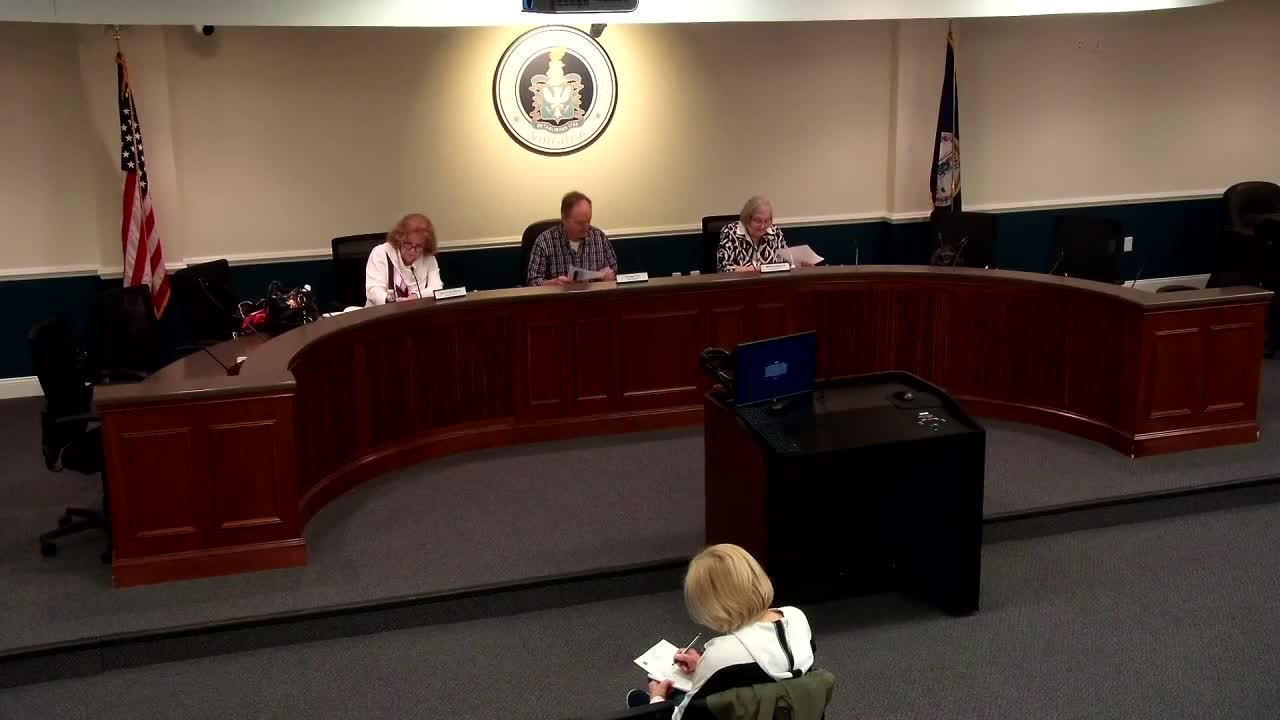
Harrisonburg City Electoral Board members heard a report on April 14 from Mark Banks, the city’s director of elections, who reviewed logistics and deadlines for the June primary, proposed a time change for the post-election canvass and described progress on a digital provisional-ballot log pilot with KnowInk.
Banks told the board that absentee logic-and-accuracy testing is scheduled for Monday, April 28, at 3 p.m., and that he proposes the election-day logic-and-accuracy (L&A) test for Monday, June 2, at 1 p.m. He also presented officer-training dates for early voting and the primary, and asked the board to set a standard start time for the canvass and provisional-ballot hearing the day after the election.
Why it matters: the board must set firm times and approve routine administrative steps so ballots, training and staff are in place before early voting begins. Banks said consistent, “evergreen” notice language and a fixed start time for the provisional hearing will reduce paperwork duplication and printing costs.
Banks said he will set the provisional-ballot hearing to begin at 11 a.m. on the day after the election going forward, noting that although the canvass technically opens a few minutes earlier to allow the board to gavel in, the public-facing provisional hearing time on notices will be 11 a.m. He explained the change reflects the advent of same-day registration (SDR), which makes it unlikely the office can produce full recommendations to the board by noon the day after some elections.
“We have been starting it at around noon. The reason why we had originally settled on noon was because that would give my office enough time to review the provisionals and give you all a recommendation,” Banks said. “With the advent of same-day registration, the likelihood that we're going to have a recommendation in time the next day is probably … not very likely.”
On ballots and turnout, Banks said he plans to order roughly 80% of registered voters’ ballots (about 40% for each party in the dual primary), which he estimated would amount to “somewhere around 9 to 10,000 ballots per primary,” while keeping ballot-on-demand systems available as backup.
Banks gave turnout estimates based on historical comparisons and local factors. He said Harrisonburg historically has had extremely low turnout in similar primaries and suggested a realistic turnout could be as low as 1%, though he said planners should “build in a buffer” and allow for higher turnout if circumstances change.
The director also briefed the board on a pilot effort with KnowInk to move the provisional-ballot log from paper to a digital poll pad. Banks said the first goal is modest: use the poll pad as the provisional-ballot log so staff can stop copying paper entries into a separate ledger, then work toward having voters’ provisional/SDR data entered digitally if that can be implemented within the bounds of Virginia law.
“Ideally … we have them data enter all their info rather than on a paper envelope,” Banks said. For the primary, he said his immediate aim is to replace the paper log; the paper envelope would still be completed and kept as the legal record, with the digital log used as an operational aid and, if necessary, printed and redacted for hearings.
Banks reported on the annual voter-placement audit that compares the local voter database to GIS mapping. The audit identified six people registered in Harrisonburg who should be county voters; the office worked with the county and corrected those cases. The audit also identified 25 city voters placed in incorrect precincts; those were corrected. Banks said a subset of those errors—about eight—stemmed from a small offshoot of South Dogwood that was addressed in nonsequential order when developed, which required manual fixes.
He described recurring address challenges that complicate precinct placement, including multifamily buildings that cross the city–county line on Old Furnace Road and a small stretch of Dorval Street where parcel lines cross the boundary. He emphasized that the voter-registration standard is where a person “lays their head at night,” which can differ from tax or mailing-address rules.
Other schedule and deadline items Banks gave the board: early voting begins May 2; first Saturday early voting is June 7; last day of early voting is June 14; primary election day is June 17 (also the deadline for independent-candidate filings); last day to register for the primary is May 27; last day to request an absentee ballot by mail is June 6; the canvass begins June 18; the office must complete same-day-registration data entry by 5 p.m. Friday, June 20; and a required report to the state is due May 12.
Banks said the office will reappoint the same machine custodians used previously for the 2025 election season and will bring a formal list for the board to approve in new business. He also described staffing plans for early voting, including using two officers most days and increasing staffing on the first weekend and Saturdays; he said the office can add temporary staff if turnout spikes.
The board approved routine meeting business before Banks’ report: the agenda and prior meeting minutes were moved and approved by voice vote. At the conclusion of the open session, a board member moved to enter closed session to discuss personnel and election-security matters pursuant to Section 2.2-3711(A) and Section 24.2-410.2 of the Code of Virginia; the motion passed by voice vote.
Banks asked the board whether it wanted the canvass to start at 10 a.m., 11 a.m. or noon; after discussion the board agreed on 11 a.m. for the provisional hearing time going forward so that notices can be standardized. Banks said he will circulate formal notices to party chairs and will finalize training dates with the board by email.
The presentation included material the director said he will review further in closed session and documents the board may refine before the June primary, including a proposed canvass checklist and an ADA compliance checklist for polling places.
Ending: The board recessed into a closed session after a motion to discuss personnel and election-security matters; no final decisions from the closed session were announced in the transcript excerpt provided.