Get Full Government Meeting Transcripts, Videos, & Alerts Forever!
Get email alerts on the Municipal Budget topic
No spam. Unsubscribe anytime.
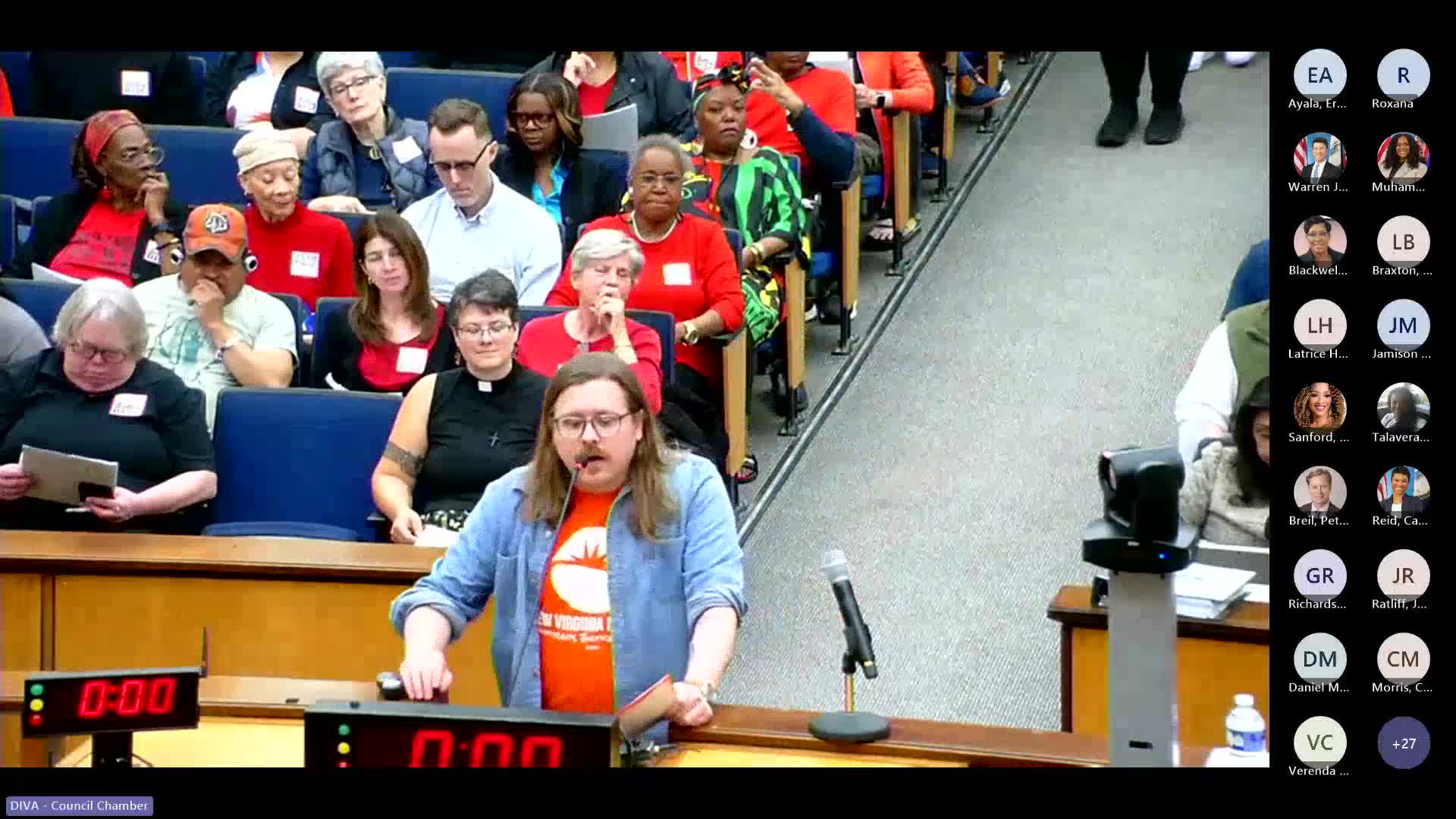
Richmond public speakers press council to restore mobile‑home repairs, fund affordable housing and school contracts during budget hearing
Summary
At a public hearing on the mayor—s proposed budget, dozens of residents, housing advocates and educators urged the Richmond City Council to add $1 million for mobile‑home repairs, allocate $8.2 million from expiring tax abatements to the Affordable Housing Trust Fund and fully fund Richmond Public Schools collective bargaining agreements.
Richmond City Council held a public hearing on the proposed fiscal‑year budget Monday, and dozens of residents, nonprofit leaders and school staff told council members the plan underfunds services they said protect renters, children and low‑income homeowners.
Speakers front‑loaded three specific requests: restore $1,000,000 for mobile‑home repairs, include $8,200,000 from expiring property tax abatements for the Affordable Housing Trust Fund as required by city ordinance, and fully fund collective bargaining agreement (CBA) raises for Richmond Public Schools staff.
The hearing opened after the council approved procedural items: the council adopted the meeting agenda as amended and approved the consent agenda. Those two motions passed with unanimous recorded votes by council members present. The council then held the public hearing on budget ordinances (items listed by the clerk as ordinance numbers 202557 through 202563).
Advocates described immediate harms they say the proposed budget would leave unaddressed. "Richmond has the second highest eviction rate in the country," said Warren Campbell, a First District resident and community organizer with New Virginia Majority. Campbell urged the council to expand the Family Crisis Fund and eviction diversion resources that he said keep families housed.
Martin Weggebreich of Richmonders Involved to Strengthen Our Communities (RISC) summarized the group—s fiscal complaints: "The proposed budget before you cut $200,000 from the eviction diversion program," he said, and it also removes funding from mobile‑home repair programs that he and others said currently help families living in unsafe conditions.
Multiple speakers told council members they had been promised money by the mayor that did not appear in the draft budget. "In multiple meetings over the last four months and at our Nehemiah action, $800,000 was committed in the budget for mobile home repairs by the mayor," said Marvin Gilliam, a pastor and RISC co‑president, adding that residents of mobile parks were not consulted about a proposed redirection of that money to a project called Eden's Village.
Residents described conditions they said require immediate repairs: collapsing roofs, pervasive mold and extreme temperatures. "A roof leaks every time it rains, and I am afraid that it will collapse on top of my family," said Elva (surname not specified), a mobile‑home resident and RISC member, through a Spanish phrase at the conclusion of her remarks.
Supporters of the Affordable Housing Trust Fund cited a city ordinance, section 12‑46, that they say requires expiring tax abatements to be credited to the trust fund. Several speakers repeated a figure from a prior analysis of expiring abatements: about $8,200,000 in the current cycle. "Follow the law and put the $8,200,000 in the budget," said multiple RISC speakers, including Janice Lacey and Alex Krieger.
Educators and union leaders pressed council to honor negotiated raises. "Educator working conditions are our students' learning conditions," said Daryl Turner, a preschool teacher and Richmond Education Association (REA) member, and Anne Forrester, REA president, said the teachers— contract funding should not be deferred or used as leverage in budget negotiations.
Other priorities raised at the hearing included preserving funding for the Office of Community Wealth Building (OCWB), continued support for early childhood care and education trust funds, and maintaining the Family Crisis Fund and eviction diversion programs. Nonprofits and residents told council that the Family Crisis Fund frequently pays rent or small bills that prevent eviction and that the pool of funds must grow to meet need.
Council members acknowledged the volume of public comment and said they and staff will continue to work through amendments. Councilwoman Gibson noted her office and others were developing alternative funding plans: "We developed a strategy on how to revise the budget to fund what I believe are critical needs," she said, listing the Family Crisis Fund, eviction diversion programs, public school funding and a rental inspection program as priorities.
The council indicated it will release council amendments publicly ahead of a follow‑up meeting where members will vote on a revised budget. For now, the hearing leaves several outstanding questions about how the mayor—s proposed figures will be adjusted and which commitments will be codified in the final ordinance.
Questions and details raised at the hearing that remain unresolved include how the administration proposes to allocate expiring abatement revenue, the scope and per‑unit cost of the mobile‑home repair program, and whether the RPS budget will cover all negotiated CBA increases.
The council's next budget work sessions and the upcoming public meeting on amendments will determine whether the amendments advocated at the hearing are adopted into the final budget.