Get Full Government Meeting Transcripts, Videos, & Alerts Forever!
Get email alerts on the Septic Code topic
No spam. Unsubscribe anytime.
Skagit County begins updates to on-site sewage code to match new state rules
Summary
Skagit County Public Health presented proposed revisions to local on-site sewage (septic) regulations to align with Washington State Board of Health rule changes and to add local clarifications and new operational requirements; work sessions and a public hearing are planned.
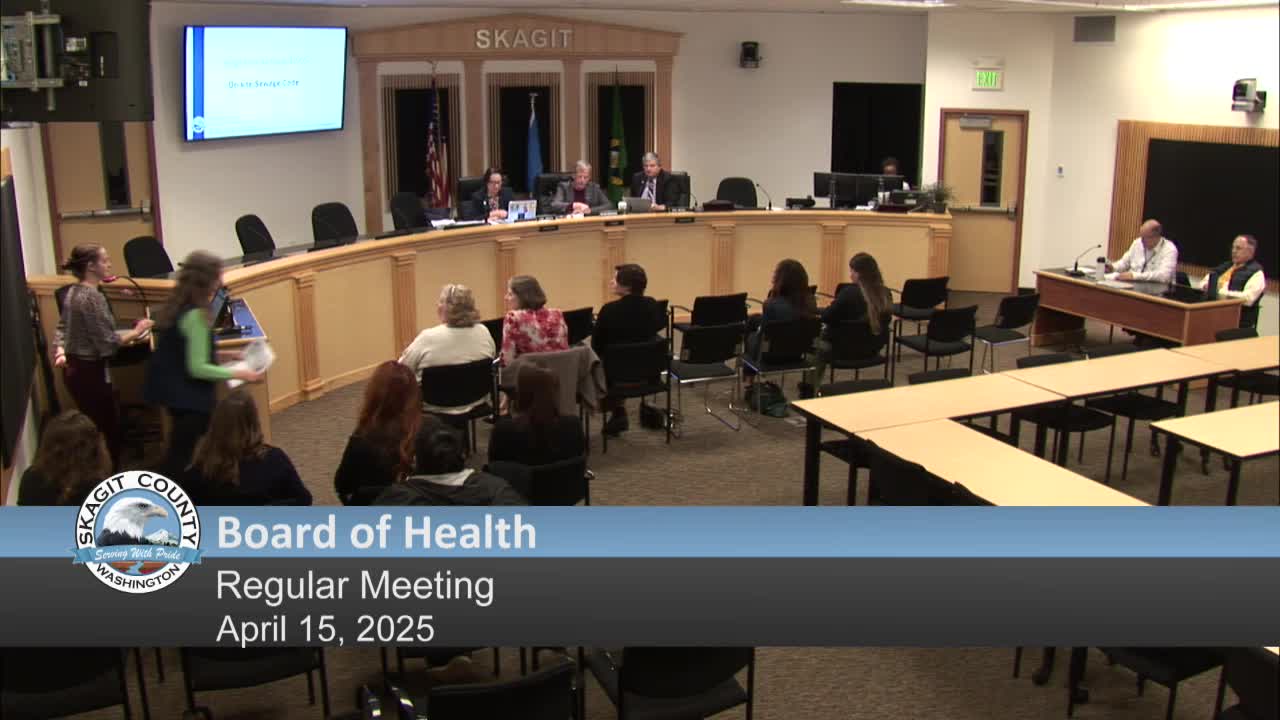
Skagit County Public Health presented proposed revisions to the county's on-site sewage (septic) code on April 15, saying the changes are driven by recent Washington State rule updates and by local practice that had not been codified.
Charice Gaynor, an environmental health specialist with Skagit County Public Health, told the Board of Health that the local update process began after the Washington State Board of Health adopted revisions to the on-site sewage rules (WAC 246-272A) and that local codes “must be as stringent as the state code. We cannot be less stringent, and we can add additional, regulations or requirements.”
Gaynor outlined a timeline and steps taken so far: initial local drafting began in June 2024, the draft was sent to the Washington State Department of Health for review in September 2024, technical advisory sessions with local installers and designers were held in December 2024, legal review occurred in February–March 2025, and Board of Health work sessions have been held in March and April 2025. Gaynor said the county expects further work sessions later in April and hopes to schedule a public meeting and public hearing in May or June to begin a formal comment period.
Key proposed changes described in the presentation include: adopting state department standards and guidance explicitly into local code; updating permitting language to match the county's new Tyler Enterprise permitting software and aligning application-fee payment timelines with Planning and Development Services; clarifying commonly asked definitions such as continuing education units (CEUs) and the method for determining a high seasonal water table (noting the county’s current practice requiring a high-seasonal-water-table assessment when depth to water is 18 inches or less); establishing countywide timelines for submission of inspection and pumping reports (currently required within 30 days in Marine Recovery Areas); and adding new local requirements the state requires but the county had not previously enforced, such as holding-tank operational permits.
Gaynor also described proposed professional-certification changes: a two-level certification structure (level 1 and level 2) for installers, operation & maintenance inspectors, and pumpers so that work on more complex systems is performed by appropriately certified providers. She said the two-level certification approach was supported by providers during the technical advisory group sessions.
Another change required by state rule is removal of a local waiver the county had used for property-transfer inspections of vacant structures; state rules do not allow the vacancy waiver, so the county must require inspections prior to property transfer regardless of vacancy. Gaynor said the county will also consider waiving the transfer-inspection requirement when a new system permit has already been submitted for replacement.
Board members thanked staff for a well-documented draft and extensive outreach to local providers. Commissioner Janicki praised the annotated work docket and said the materials helped the board “pull a commissioner through an education process that you hadn't quite planned on.”
Next steps, as presented: staff will incorporate Board feedback from the remaining work session(s), publish a final draft for a public meeting and comment period, then return for a public hearing with potential adoption in June.
Votes at a glance: the board approved routine administrative minutes for prior meetings earlier in the session (see "Votes at a glance" inside the related community-health article).