Get Full Government Meeting Transcripts, Videos, & Alerts Forever!
Get email alerts on the Flood Mitigation And Stormwater topic
No spam. Unsubscribe anytime.
Seward Bear Creek Flood Service Area prioritizes riprap purchases, extends Lost Creek mitigation design
Summary
Program manager Nicholas Chapman told the assembly the Seward Bear Creek Flood Service Area will concentrate FY26 contract funds on riprap to replace high‑maintenance berms, extend Lost Creek mitigation design from 3,000 to about 7,000 river feet, and proposes charging up to 25% of program manager time to the road service area.
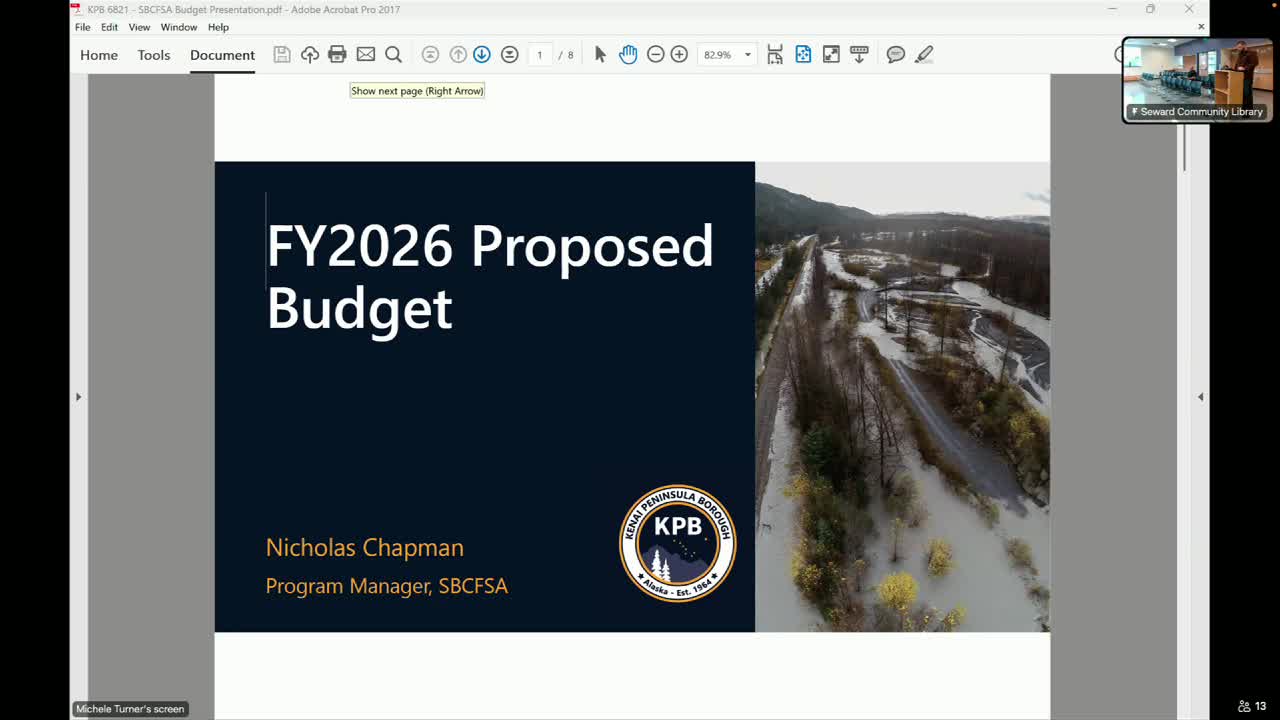
Nicholas Chapman, program manager for the Seward Bear Creek Flood Service Area, presented the service area’s FY26 priorities to the Kenai Peninsula Borough Assembly Committee of the Whole on April 15 in Seward.
Chapman said the flood service area is a small program with two staff and that the board of directors sets annual priorities for short‑term maintenance, planning and long‑term mitigation. Work in FY25 included establishing ground control and completing standardized sediment‑management plans for 10 sites, completing three mitigation projects, putting one project out to bid, responding to two emerging situations and assisting the borough Office of Emergency Management with three emergencies. Chapman also said the service area has purchased drone equipment for annual creek‑bed mapping to monitor sediment loads.
For FY26, Chapman said the service area will repurpose much of its contract services budget to buy riprap and replace high‑maintenance berms with revetments, and will pursue new design plans to extend Lost Creek mitigation from about 3,000 river feet to roughly 7,000 river feet downstream. He also identified mitigation work planned at Spruce Creek and sediment removal at Upper Kujak Creek as significant project items.
Budget and staffing note: Chapman said the only significant proposed change in the FY26 budget is an interdepartmental charge proposal to allow up to 25 percent of his time to be chargeable to the road service area “in an effort to provide better service to the taxpayers.” An assembly member pointed out a typographical error on the expenditure summary: the FY26 figure shows a 5.51 percent change but Chapman confirmed it should be a negative 5 percent change (a reduction).
Why this matters: the program’s sediment‑management and revetment work aims to protect highways, rail lines and private property from annual sediment movement and overtopping events; Chapman showed a photograph of Salmon Creek overtopping the railroad tracks and the Seward Highway at mile 5 as an example of exposure.
Long‑term outlook: Chapman said the long‑term challenge is replacing berms with riprap revetments and keeping up with the annual sediment removal necessary to maintain creek conveyance. He thanked the assembly for the opportunity to present and invited questions; the presentation ended with no formal assembly action recorded.