Get Full Government Meeting Transcripts, Videos, & Alerts Forever!
Get email alerts on the Fire And Ems Budget topic
No spam. Unsubscribe anytime.
Bear Creek Fire Service Area proposes standby pay, ambulance gurney in FY26 budget
Summary
Chief Richard Bracken told the Kenai Peninsula Borough Assembly Committee of the Whole the Bear Creek Fire Service Area will add standby pay for paid staff, is purchasing a new ambulance and is planning ALS training while relying on volunteers and Seward Volunteer Ambulance Corps for transport.
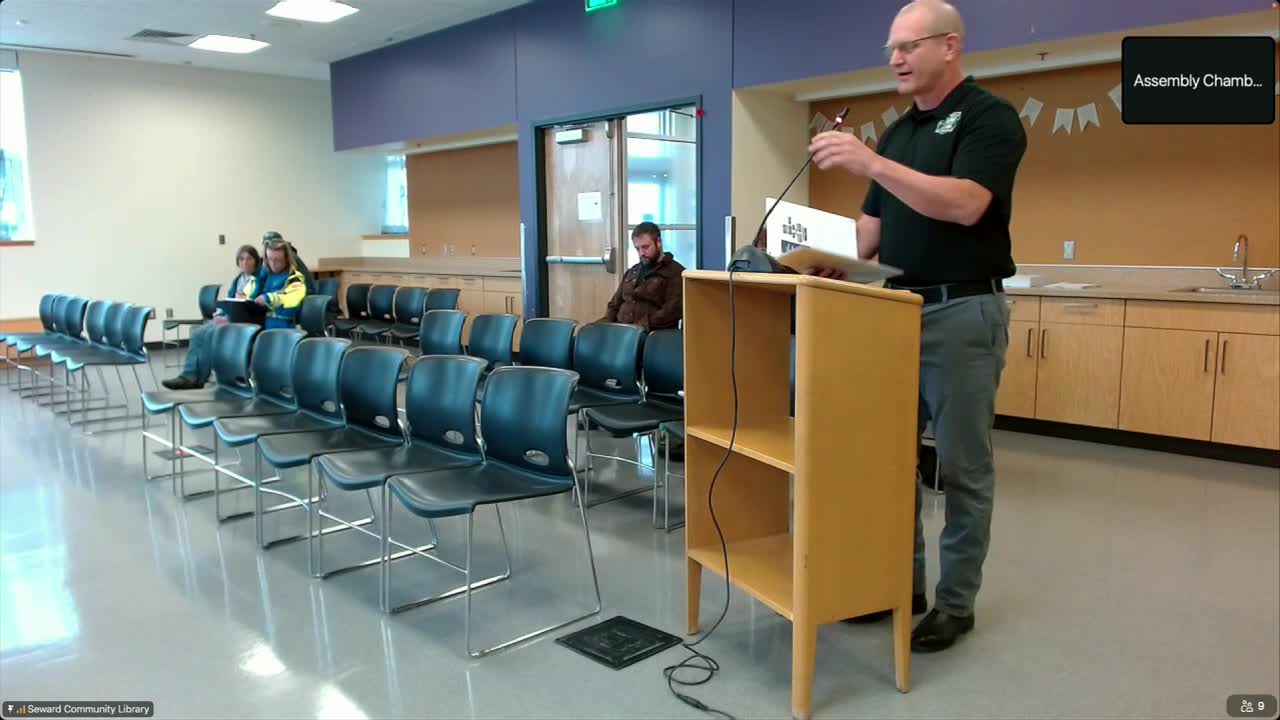
Chief Richard Bracken, chief of the Bear Creek Fire Service Area, told the Kenai Peninsula Borough Assembly Committee of the Whole on April 15 in Seward that the department’s FY26 budget includes new standby wages for paid staff and a capital request tied to a new ambulance.
The budget proposal adds a standby wage that increases personnel costs by $33,559, Bracken said, and requests $45,000 to purchase and install a power gurney and loading system timed to the arrival of a replacement ambulance that is currently in production. The district plans to expand in-house emergency medical training to offer EMT‑2 and an advanced life support (ALS) program, Bracken said.
The changes come as Bear Creek prepares for “stand‑alone transport” if regional partners face gaps. “Bear Creek will begin preparations to provide stand alone transport to the service area if the need arises,” Bracken said. He also told the assembly Bear Creek currently has about 30 volunteers and roughly 50 calls per year across fire, wildland and EMS responses.
Why this matters: the budget items are meant to reduce response times and provide a guaranteed responder for transport when Seward Volunteer Ambulance Corps or other partners face simultaneous calls. Assembly members pressed for details about staffing, costs and reliance on regional partners.
Budget and capital highlights: Bracken said the personnel increase is driven by the new standby wage, with additional FICA and PERS pushing the personnel-line increases to $33,962. Capital outlay shows a net increase of $11,900 for items including a laptop, monitor and additional structural firefighting gear; the FY26 capital request includes $45,000 for the ambulance gurney and loading system. Bracken listed longer-term replacement needs through FY30–34 that he anticipates will total about $1,278,000 for major apparatus (two snow machines, a side-by-side, command unit, enclosed search-and-rescue trailer, a tanker and a pumper). He also identified planned replacements earlier than that: a snow machine at about $20,000 and a potential SCBA compressor around $50,000.
Training and operational changes: Bracken said Bear Creek has upgraded basic certifications for paid staff and volunteers from “emergency trauma technician and fireground support” to EMT‑1 and Firefighter I, and that the department will roll out an EMT‑2 course taught in‑house this fall. He said the department added four instructor-level members and replaced two 4‑wheelers in cooperation with Volunteer Inc., reducing capital pressure in FY27.
Regional reliance and transport: Assembly member Ms. Eklund asked whether Bear Creek intends to stop using Seward Volunteer Ambulance Corps for ALS and transport; Bracken said the goal is not to replace SVAC but to be prepared for gaps or overlapping calls. “We don’t want to be caught flat footed in the event that maybe there’s an overwhelming call volume,” he said. Bracken said SVAC currently provides the ALS and transport component for Bear Creek, and an assembly member noted SVAC runs about 600 calls per year.
Questions and concerns raised: Assembly members asked about the district’s fund balance and how new standby pay would be funded; one member characterized the district’s bond payment as about $86,000 and noted one mil’s revenue roughly as $225,000 per year, as part of the budget context. Members also pressed how often volunteers remain overnight in the new living quarters; Bracken said overnight staffing has not matured as quickly as hoped but several night shifts have been staffed by volunteers. He and the assembly flagged housing shortages and limited water supply/draft sites in subdivisions as ongoing operational constraints that affect volunteer recruitment and turnout.
Looking ahead: Bracken said increasing the volunteer shift and instituting standby pay are intended to reduce response times and provide a guaranteed minimum responder for transport. The presentation concluded without a formal assembly vote; members said the district and assembly will continue discussing the budget in follow-up sessions.