Get Full Government Meeting Transcripts, Videos, & Alerts Forever!
Get email alerts on the Lgbtq Health Protections topic
No spam. Unsubscribe anytime.
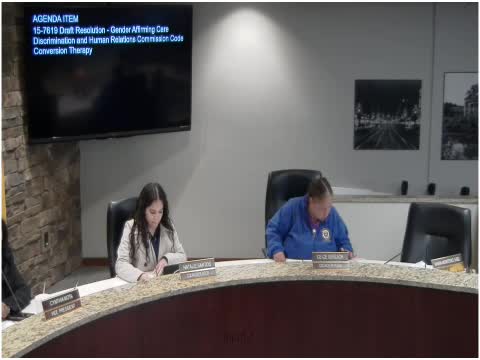
Committee hears broad public support for Allentown resolution to protect LGBTQ+ health care and declare city a safe haven
Summary
A committee discussed a draft resolution declaring Allentown a safe and welcoming haven for LGBTQ+ residents and urging protections for gender-affirming health care; supporters urged passage and several council members signed on for introduction.
A City Council committee heard extensive public testimony supporting a draft resolution that would declare Allentown a safe and welcoming haven for LGBTQ+ residents, urge county and state officials to support related legislation, and direct city personnel to shield residents and providers from out-of-state legal actions when possible.
Council member Hanlon introduced the draft resolution as “a resolution to protect and grant refuge to members of the LGBT plus community and people fleeing states with anti LGBTQ plus laws, declare Allentown a safe and welcoming haven, for the LGBTQ plus, community, trans community, urging county and state officials to support the AFERSAID legislation.”
Supporters who testified described the measure as both symbolic and consequential. Liz Bradbury, chair of the Lehigh County Human Relations Commission and representing Keystone Equality, said passing the resolution would reaffirm the city’s commitment to health care and civil rights and urged the council to update the city’s human relations ordinance, which was passed in 2002. “Please stand up to hate. You can do it. Please support this resolution,” Bradbury said.
Krista Brownlee, interim executive director of the Bradbury-Sullivan LGBT Community Center, urged the council to support health-equity protections and cited a 2024 statewide needs assessment finding that “40 percent of all respondents identified the need for access to affirming care.”
Corinne Goodwin, executive director and founder of the Eastern Pennsylvania Trans Equity Project, described rising demand for services and legislative threats: her organization serves “in excess of 8,000 people a year” and saw a 200% increase in support-group attendance in early 2025. Goodwin cited research she said found that gender-affirming care for transgender youth is associated with a 60 percent reduction in depression and a 73 percent reduction in suicidality and urged the council to instruct city personnel to pursue reasonable actions to shield local providers and patients from out-of-state legal actions.
Several people with lived experience described the personal impact of gender-affirming care. Amelia Conway, a trans woman and former Allentown resident, said gender-affirming care was “life saving” for her and gave her “a sense of community.” Robin Gao, who receives care in Allentown, said providers’ uncertainty about out-of-state legal actions is “not the most reassuring” and that the resolution could give providers confidence to continue providing care. William Gorecki, a lifelong Allentown resident and employee of the Da Vinci Science Center, said he observed improved school engagement in a student receiving hormone replacement therapy.
Not all speakers supported the draft resolution. Quinn Allen, an Allentown resident, said adults should be free to make their own choices but urged caution for minors, arguing children need time to mature before making medical decisions.
Committee members said the resolution is a moral statement rather than a change in law. Multiple council members indicated support and signed on to submit the resolution for introduction at the next council meeting; council members Cece Gurlog, Afa (first name not recorded in transcript) and Napoli were recorded as signing on. The committee arranged to place the draft resolution on the next available City Council agenda for introduction; one committee member suggested April 16 as the target meeting for introduction.