Get Full Government Meeting Transcripts, Videos, & Alerts Forever!
Get email alerts on the Permitting Fees topic
No spam. Unsubscribe anytime.
Allentown committee backs Bill 33 to consolidate building permits, standardize valuations
Summary
The Allentown City Community and Economic Development Committee voted to forward Bill 33, which combines multiple trade permits into a single permit, standardizes project valuations and extends permit expiration to five years under the Pennsylvania Construction Code.
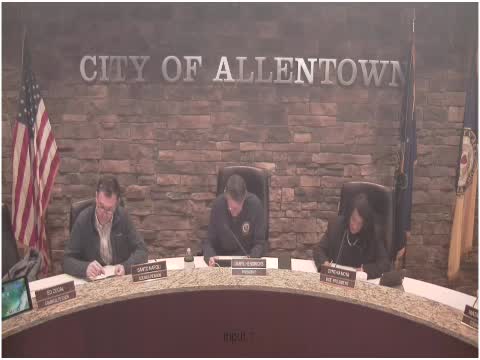
The Allentown City Community and Economic Development Committee voted to forward Bill 33 with a favorable recommendation to the full City Council after hearing staff explain changes that would streamline permitting, include plan review in permit fees and standardize project valuations.
Bill 33 would amend the city code to consolidate building, electrical, mechanical and plumbing permits into a single permit per project, set a standardized valuation method for calculating fees, and change permit expiration from one year to five years to follow the Pennsylvania Construction Code. Committee members voted by voice to send the measure on to the full council.
Heidi Westman, director of building standards and safety, told the committee the city has moved to the EnerGov permitting system and studied five years of valuation and revenue data to determine fees. "This whole process is gonna be streamlined for the customer who's applying. It's also for the staff who's managing all of these permits," Westman said. She described a fee structure the staff recommended: 1.5% of project valuation for commercial projects and 1% of the cost of work for residential projects, with plan review and certificate-of-occupancy processing included in the single permit fee.
Joe Granzell, construction and building superintendent and building board official, described the standardized valuation method staff will use: "When they submit an application for a project, now they can submit for building, electrical, mechanical, plumbing all on 1 permit instead of 4. . . . We're gonna take the square footage and multiply it by the multiplier from ICC data to get a fair evaluation." Granzell said staff will cross-check applicants' stated project costs against ICC (International Code Council) building valuation data and a rolling average to ensure consistent, equitable fees across similar projects.
Staff said the change also addresses the previous use of third-party plan reviewers. Under Bill 33, plan review is wrapped into the city fee so applicants will not need to obtain a separate third-party review before submission. Westman said that will reduce time and expense for applicants and reduce duplicate reviews by city staff.
Committee members voiced support. Vice President Mota and other council members said the five-year permit period and single-permit approach would reduce repetitive data entry and time spent managing multiple permits, particularly on large projects. One council member noted the change would benefit homeowners who pause projects, because a permit would not automatically expire after one year if work was ongoing and there was no lapse longer than 180 days.
Staff emphasized the bill is not intended as a revenue increase but to align fees with the actual cost of services. Westman told the committee the fee study aimed to ensure the department is "being fair and reasonable with the customers," and that bringing plan-review fees into the city process would recapture charges previously paid to third-party reviewers.
A motion to forward Bill 33 with a favorable recommendation to the full council passed by voice vote; the committee chair announced the meeting adjourned afterward.
Votes at a glance Bill 33 — Motion to forward with a favorable recommendation to the full City Council. Outcome: approved by voice vote; all in favor said "aye." Mover and seconder: not specified in the committee record.
Ending The committee did not set an implementation date; staff said the measure was the first of several legislative changes intended to modernize permitting and to address housing and vacant-property issues. The bill now moves to the full City Council for consideration.