Get Full Government Meeting Transcripts, Videos, & Alerts Forever!
Get email alerts on the Public Safety topic
No spam. Unsubscribe anytime.
Supervisors continue debate on foot-patrol pilot, direct return Sept. 19
Summary
The Board of Supervisors continued two related measures to create a one-year foot-patrol pilot and a decennial review of police district boundaries, directing staff to return with further analysis and seeking police-department staffing data before final action.
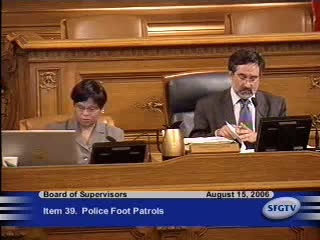
The San Francisco Board of Supervisors on Aug. 15 voted to continue two items — an ordinance to require a 10-year review of police district station boundaries and a one-year pilot program requiring foot patrols in crime-impacted areas — until a special board meeting on Sept. 19.
The measures were introduced by Supervisor Ross Mirkarimi as an effort to increase beat/foot patrol presence in select districts. "I wanna see foot and be patrols citywide," Mirkarimi said during the discussion, offering his district as a pilot and arguing the proposal was the catalyst to revive a strategy the city used in the past.
Supporters said the pilot could help restore community policing in high-crime neighborhoods. Supervisor Chris Daly, who joined the discussion, said he was prepared to support the measure but raised concerns about the city's ability to staff a citywide program without additional police hires, noting that the department had previously failed to fund staffing changes during the budget process.
Opponents and cautious colleagues asked for more documentation demonstrating how beat patrols would affect staffing citywide. Supervisor Jake McGoldrick said there was "no report in the file" from the Police Department or the Office of Legislative Analyst and requested a professional appraisal of collateral effects on assignments and resources before final action.
Supervisor Mirkarimi said his office had compiled research and case studies from other cities and offered his district as a pilot to avoid displacing officers from other districts. Several supervisors repeatedly urged the Police Department and Police Commission to provide a report about operational impacts, staffing implications and funding sources.
On a motion by Mirkarimi, seconded by Supervisor Jake McGoldrick, the board continued items 38 and 39 to Sept. 19 and asked that the Police Department, Police Commission and the Office of Legislative Analyst provide documentation and staffing impact analyses in advance.
The debate included repeated references to recent violent incidents and a desire among several supervisors to accelerate community policing work. But the board emphasized it wanted an evidence-based implementation plan, including whether new hires in the adopted budget would be allocated to foot-patrol duties.
The continuation leaves the ordinance language and pilot design intact for now; the Sept. 19 return is intended to include a police-department staffing report, cost estimates and a plan for monitoring the pilot's effectiveness.
Ending note: The board set the return date to Sept. 19 and asked that the Police Department and related city analysts provide staffing, budget and operational impact materials in advance of that hearing.