Get Full Government Meeting Transcripts, Videos, & Alerts Forever!
Get email alerts on the Public Service Grants topic
No spam. Unsubscribe anytime.
Rules committee amends public service grant rules to stretch funds; caps top award at $100,000
Summary
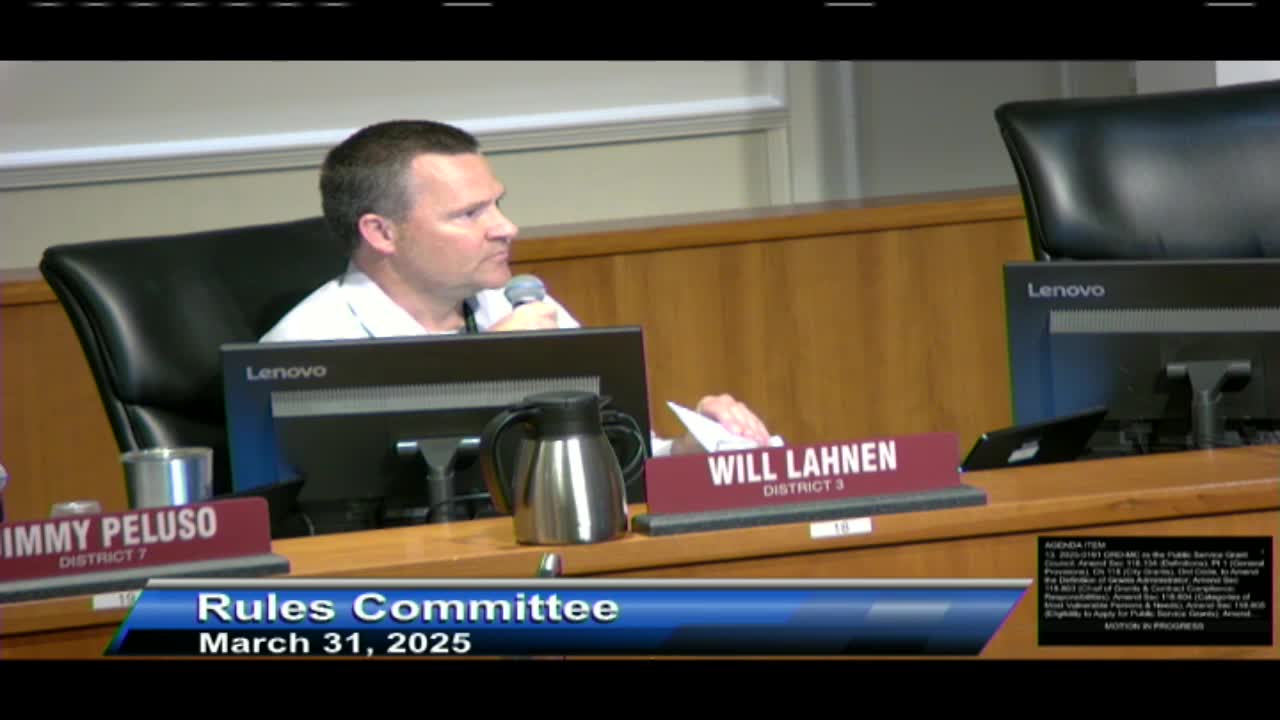
The Jacksonville City Council Rules Committee on March 31 approved changes to the Public Service Grant rules intended to broaden which nonprofits receive funding and to limit the maximum award per category to $100,000.
The Jacksonville City Council Rules Committee on March 31 approved changes to the city's Public Service Grant (PSG) rules intended to spread limited dollars across more nonprofit groups and to encourage partnerships among providers.
The committee voted 6-1 to pass bill 20250191 as amended. The most consequential change adopted was an amendment offered by Councilman Matt Miller to reduce the maximum award per category from $150,000 to $100,000, a move Miller said would have allowed 19 additional organizations to receive awards in last year's cycle in the committee's simulations.
Why it matters: Committee members said they face smaller city budgets going into the next fiscal year and want PSG dollars to reach more organizations. PSG staff and the PSG Council chair warned that reducing the cap will force some awardees to scale back programs that currently count on higher awards, and will increase administrative workload for the grants office.
PSG chair Joy Hervey opened public comments on the item and described a multi-year review process involving UNF researchers and nonprofit stakeholders that produced the proposed changes.
The substitute legislation that advanced includes three headline reforms: limiting how many awards a single agency may receive in a cycle (to one application per category), creating clearer MVP (most valuable program) categories to guide scoring, and authorizing a new mini-grant or neighborhood community grant category designed to serve smaller organizations. Maribel Hernandez, grants and contract compliance, told the committee the proposed rule that limits awards by category would reduce instances where a single organization receives a disproportionate share of PSG funding.
Miller's amendment and council debate: Miller pressed for the $100,000 cap after reviewing last year's scorings and finding many groups clustered just below the funding cut line. "If this change had been in place last year, 19 more organizations would have received public service grants," Miller said during the committee discussion. PSG staff responded that while the cap would increase the number of awardees, it also could require some organizations that previously budgeted for larger awards to reduce services or staffing. PSG staff also noted the new mini-grant program the PSG Council plans to recommend as a separate mechanism to reach very small organizations.
Council members split on the trade-offs. Supporters argued the cap would spread scarce dollars farther as the city anticipates fiscal headwinds next year; opponents warned the reduction risks destabilizing programs that rely on larger grants to operate effectively.
Vote and next steps: The committee approved the ordinance as amended (6 yeas, 1 nay) and forwarded it to the full council. PSG staff said some additional changes remain under discussion and that the PSG Council will meet again to finalize MVP categories and program details before the next grant cycle. Committee members asked PSG staff to consult further with nonprofit leaders about the cap and implementation details ahead of the council vote.