Get Full Government Meeting Transcripts, Videos, & Alerts Forever!
Get email alerts on the International Conflict topic
No spam. Unsubscribe anytime.
Hundreds testify at San Marcos meeting as residents press council on Gaza ceasefire resolution
Summary
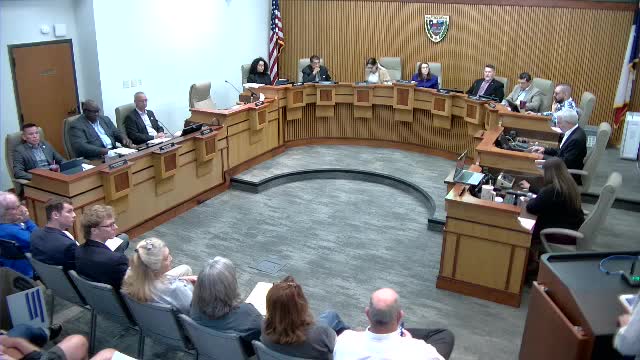
Hundreds of residents filled San Marcos’ council chambers for more than three hours to press the City Council to adopt a nonbinding resolution calling for an immediate and permanent ceasefire in Gaza, an arms embargo on Israel and recognition of Palestinian sovereignty.
Hundreds of residents filled San Marcos’ council chambers for more than three hours on Tuesday to press the City Council to adopt a nonbinding resolution calling for an immediate and permanent ceasefire in Gaza, an arms embargo on Israel and recognition of Palestinian sovereignty.
The hearing featured sustained appeals from students, religious leaders and longtime residents who asked the council to express solidarity with civilians caught in the conflict. Organizers framed the measure as a symbolic statement of the city’s values and — for some speakers — as a means to protect local residents, including international students, from retaliatory actions.
“I'm here to ask you to strongly consider passing a resolution calling upon our federal government to stop supplying weapons at our expense to the Israeli military,” said Scott Cove, who identified himself as a resident of the Victory Gardens neighborhood. "We should come together to reject all forms of hate and bigotry," he told the council.
Organizers and students said the resolution is intended to prompt Washington to follow existing legal restrictions such as the Leahy Act and to reduce U.S. material support that speakers said is being used in ways that violate international law. "We are asking our city to uphold basic human rights, international law and constitutional freedoms," said Yancy Arevalo, an organizer with Palestine Solidarity SMTX.
Local academics urged the council to endorse the resolution on prudential and moral grounds. "It strikes me that this is a much more complicated issue than the oversimplifications that seem to be coming out in public discourse," said Thomas Doyle, professor of political science and international politics at Texas State University. "As far as I'm concerned, it's a matter of prudence to endorse the ceasefire resolution." Tom Alter, a history professor at the university, said he had been asked by students why university and municipal leaders have remained silent and urged council action.
Speakers described an array of local effects they tied to the conflict, including visa revocations for international students, threats of state funding cuts from state officials and public safety concerns for people who speak at rallies. Several speakers cited a recent letter from State Sen. Donna Campbell warning about possible state funding repercussions if jurisdictions adopt certain measures; others said such threats made local action more urgent.
Opponents who spoke at the meeting said the council should not take positions on foreign policy, urged attention to local problems and asked officials to avoid steps that could jeopardize state funding for the city.
Mayor Jane Houston and other councilmembers did not take a final vote on the legislation Tuesday. Instead councilmembers agreed to bring the matter back at a future meeting for formal consideration and vote after staff posts any proposed amendments on the council message board so the public can review and comment in advance. Council members asked sponsors and staff to circulate any revisions to the draft resolution ahead of that meeting.
The meeting’s public comment tally reflected an unusually high turnout: the clerk called some 68 speakers for the item and the mayor briefly paused the agenda to acknowledge the volume of testimony. Several speakers told the council they had avoided attending earlier meetings for fear of intimidation or legal consequences.
Votes at a glance: a summary of unrelated items passed during the same meeting - Conditional Use Permit (CUP) — Case CUP-25-02 (purpose-built student housing, downtown): Council approved a CUP with conditions including limits on bedroom counts and a restrictive covenant preventing sale to a tax-exempt entity for a set period. Vote recorded in the meeting: approved, 6–1. (Motions and several amendments were added by council; staff and applicants agreed to the final set of conditions.) - Alternative compliance (additional stories / same maximum height): Council approved allowing two additional stories (seven stories, same maximum height) for the same downtown student housing project. Vote recorded: approved, 6–1. - Speed-limit ordinance (various neighborhood streets): Council approved lowering speed limits on a set of neighborhood streets (Tampico St., Laredo St., South Dale St., Durango St., Juarez Ave., Monterrey St., Luciano Flores Blvd.). Vote recorded: approved, 7–0. - Certificates of obligation (general projects): Council approved an ordinance authorizing the issuance and sale of approximately $37.7 million in combination tax and revenue certificates of obligation for multiple infrastructure projects; council approved updated numbers supplied before the vote. Vote recorded: approved, 7–0. - Water/Wastewater revenue bonds: Council approved an ordinance authorizing the sale of roughly $30.45 million in water/wastewater system revenue bonds (final numbers amended and posted); vote recorded: approved, 6–1. - On-call aviation engineering firms: Council approved a five-year on-call list for general aviation engineering services. Vote recorded: approved, 6–1.
Why it matters: council authority, local impacts and symbolism A municipal resolution cannot compel federal policy. But supporters told the council that a public statement matters for residents who feel directly affected — notably international students and immigrant families — and for nonprofits that rely on federal and state funding. Many speakers argued the passage would be a moral and political signal tied to rule-of-law questions (they cited the Leahy Act and other international law references discussed during testimony).
Opponents urged the council to focus on local issues and warned that the city could face political and fiscal retaliation at the state level; some expressed that raising the topic at a municipal meeting was outside local purview. Council members signaled that they had heard both constituencies and would allow time for amendments to the draft resolution to be posted publicly before deciding whether to adopt it.
What’s next Councilmembers directed staff and the sponsors to circulate any amendments to the draft resolution ahead of the next meeting so the public can review them on the council message board. A formal vote has not been scheduled; when the item returns it will be listed on the agenda for possible action. In the meantime, councilmembers and staff said they would continue to collect public input and consider technical edits proposed by colleagues.
Reporting note: the article draws on the council’s public meeting transcript and on direct testimony from residents, students and university faculty who spoke during timed public comment. No vote on the proposed ceasefire resolution occurred at this meeting.