Get Full Government Meeting Transcripts, Videos, & Alerts Forever!
Get email alerts on the Infrastructure Sewer topic
No spam. Unsubscribe anytime.
Council approves updated Sanitary Sewer Master Plan; CIP totals roughly $100 million for build‑out
Summary
Public Works presented an updated sanitary sewer model and capital improvement program; council approved the plan 7–0. Staff said the capital plan totals about $100 million across the planning horizon and identified existing and future connection projects to be addressed through rate planning and development impact fees.
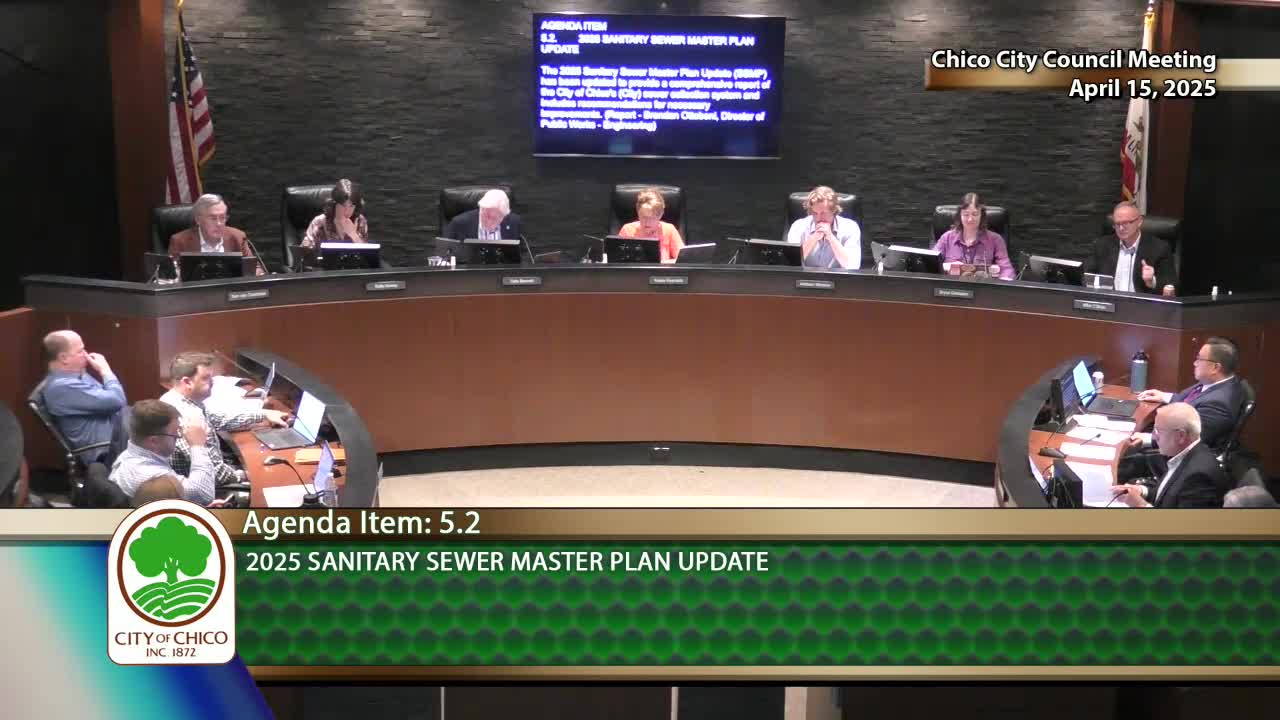
The City of Chico’s Public Works Engineering Department presented an update to the Sanitary Sewer Master Plan and an updated sewer collection model April 20. Senior Civil Engineer David Keane said the model incorporates winter flow monitoring, calibrates dry‑ and wet‑weather conditions, projects build‑out flows consistent with the Chico 2030 General Plan and produces a capital improvement program (CIP).
Keane said the city’s collection system comprises roughly 280 miles of pipe and that staff conducted flow monitoring through the winter to capture inflow and infiltration. He explained inflow and infiltration elevates flows during wet weather and suggested typical summer (dry‑weather) average daily flows are in the 5–8 million gallons per day range while peak wet‑weather flows can rise toward the treatment plant’s rated peak wet‑weather capacity.
On the modeling results and CIP, Keane said “the punch line, the capital improvement plan that comes out of this, [is] roughly a hundred million dollars over the planning horizon.” He told council the CIP splits costs between existing users (to be funded through sewer rates and replacement programs) and future users (to be funded by development through nexus study and development impact fees). He said the wastewater treatment plant peak capacity is about 27 million gallons per day and that the system currently has only one small existing deficiency identified in the model that can be addressed with sewer‑rate funds.
Keane described outreach steps: a technical workshop with local developers and engineers and a virtual public meeting. He said next steps include incorporating projects into a nexus study for impact fees and the city’s sewer rate planning process, and prioritizing projects with a flow‑trigger analysis that accounts for where development activity occurs.
Council moved to approve the master plan update; the motion passed on a roll call vote, 7–0. Staff said projects will be prioritized in coordination with the development pipeline and included in the city’s nexus and rate studies.