Get Full Government Meeting Transcripts, Videos, & Alerts Forever!
Get email alerts on the Budget topic
No spam. Unsubscribe anytime.
Prince William supervisors raise data-center levy, cut vehicle and meals taxes in budget markup
Summary
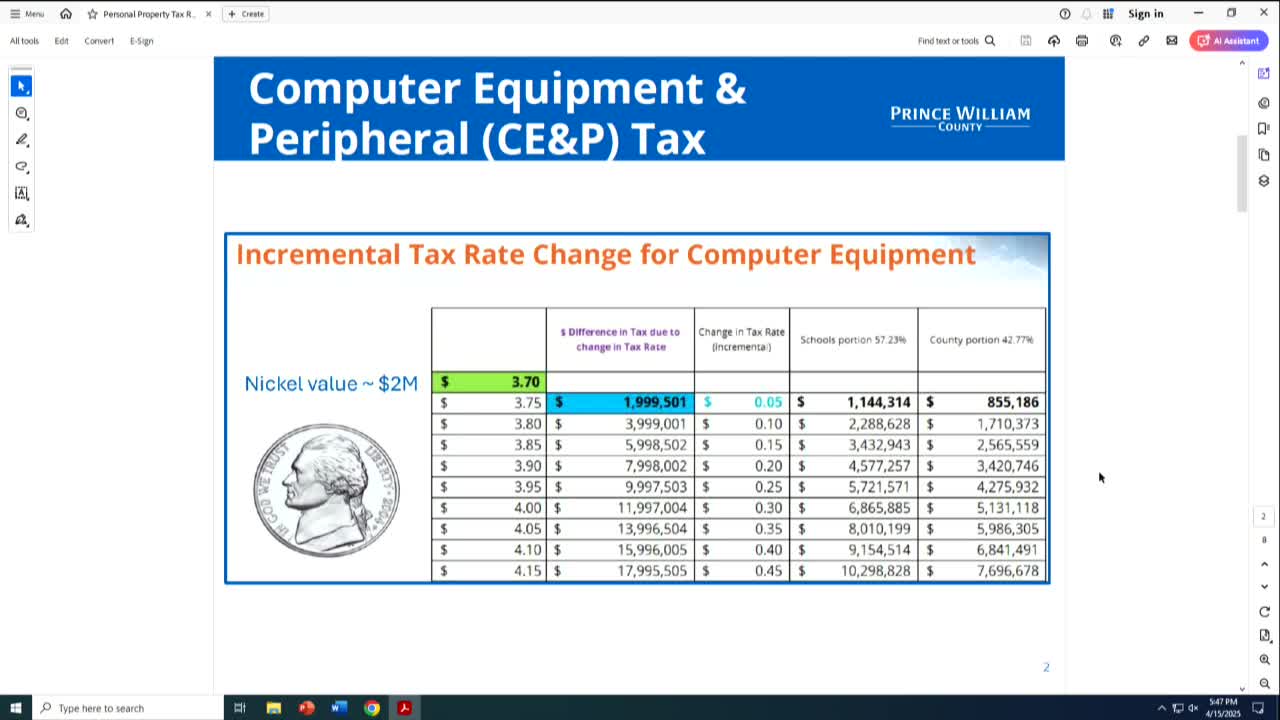
Prince William County supervisors voted Wednesday to raise the county's computer-and-peripheral tax to $4.15 per $100 of assessed value and to cut residents' vehicle and meals taxes after hours of debate during budget markup.
Prince William County supervisors voted Wednesday to increase the county's computer and peripheral tax to $4.15 per $100 of assessed value, cut the personal-vehicle tax to $3.50 and direct staff to prepare an ordinance cutting the meals (food and beverage) tax to 3 percent, while adopting a $0.906 real-estate tax rate for fiscal 2026.
The actions came near the end of a lengthy budget markup session during which supervisors debated staff requests, department priorities and how much of newly available revenue from data-center firms to apply toward tax relief. County Executive Christopher Shorter had presented a recap budget that preserved many department requests; the board's changes reallocated a portion of the projected C&P revenue to lower household vehicle bills and reduce the meal tax in a phased way.
The board's move on the C&P rate was the most consequential revenue decision: the higher C&P rate is projected to raise roughly $18 million in additional revenue compared with the budget's earlier baseline. Supervisors said part of that incremental money should be returned to taxpayers, chiefly through a lower personal-property levy on vehicles and a modest cut to the meals tax, while keeping a modest real-estate rate reduction from the February proposal.
Supervisors voted 7—1 to set the C&P tax at $4.15. The real-estate tax debate took longer: a motion to set $0.885 per $100 failed, and the board adopted $0.906 by roll call, 5—3. The vehicle-rate decision coalesced at $3.50 after several members proposed lower numbers; the board recorded consensus to move forward with that rate. On the meals tax, supervisors directed staff to prepare an ordinance to make the 3 percent change effective Jan. 1, 2026, to allow businesses time to update systems.
County officials and supervisors stressed the trade-offs. Shorter and staff repeatedly cautioned that cuts to recurring county programs this year would reduce flexibility in later budget years, especially once the full-year impact of the meals-tax change appears in fiscal 2027. Staff estimated the board's package of rate changes (C&P up to $4.15, vehicle tax to $3.50 and meals tax at 3 percent from Jan. 1) would leave the county roughly $950,000 short in FY 2026 but about $7.2 million lower in FY 2027 because of the meals-tax full-year effect; supervisors then identified one-time and recurring reductions to close the gap.
Among the items the board trimmed or delayed were parts of the parks and recreation capital allocation and a reduction in the contingency set-aside. Supervisors also agreed to review proffer accounts (developer-dedicated funds) and asked staff and the county attorney to identify whether certain projects could be funded from those proffers rather than the general fund; staff said that review would be ongoing and any eligible transfers would return to the board through the finance committee.
Votes at a glance - Computer and peripheral (C&P) tax: Increase to $4.15 per $100 of assessed value. Motion: not specified. Vote: 7 yes, 1 no (Supervisor Angry). Outcome: approved. - Real-estate tax rate: Adopt $0.906 per $100 of assessed value. Motion: not specified. Vote: 5 yes, 3 no. Outcome: approved. - Personal property (vehicles) tax: Set to $3.50 (decision recorded by roll call/consensus during markup). Outcome: adopted by board consensus/roll call during markup. - Meals (food and beverage) tax: Board directed staff to prepare an ordinance to lower the rate to 3.0 percent, effective Jan. 1, 2026 (to allow business-system changes); formal ordinance adoption scheduled for the budget-resolutions packet. Outcome: board direction to prepare ordinance. - Certification of closed session: Motion and second on the record; vote unanimous. Outcome: certified.
Discussion and next steps Supervisors emphasized that the board's choices were a balance between delivering tax relief and preserving government services. Multiple supervisors said they wanted incremental tax reductions rather than deeper one-time cuts that could destabilize the five-year plan. Several supervisors urged staff to provide more frequent vacancy and proffer reports so the board can consider alternative funding sources outside the general fund.
Staff will return revised appropriation/resolution language at the scheduled budget-adoption meeting; the meals-tax ordinance requires a public-notice schedule and therefore an effective date of Jan. 1, 2026. The board also asked the county executive and staff to provide more detailed tracking of where proffer funds might legally and practically substitute for general-fund capital items.