Get Full Government Meeting Transcripts, Videos, & Alerts Forever!
Get email alerts on the Public Safety Report topic
No spam. Unsubscribe anytime.
Lake Oswego Police report: incidents down, new programs launched and behavioral-health capacity increased
Summary
Chief George Burke and Captain Clayton Simon briefed the council on the 2024 department report: overall incidents fell, Part I crimes declined, officers launched online reporting and a drone program, and the department expanded behavioral-health response.
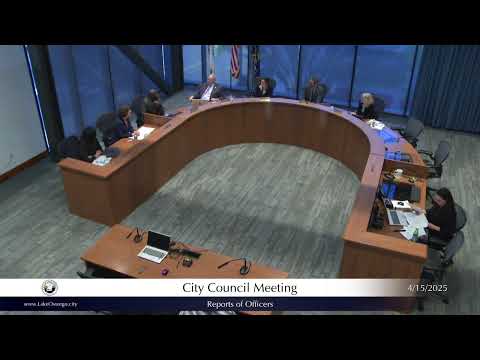
Chief George Burke and Captain Clayton Simon presented the police department’s annual report to the Lake Oswego City Council during the April 15 meeting, highlighting lower overall incident counts in 2024, new community-response tools, and staffing challenges.
The most important figures: the department reported roughly a 5% decrease in total incidents from 2023 to 2024. Part I crimes were down about 12% and Part II crimes fell about 29%. Captain Simon told the council the department responded to roughly 26,000 incidents in 2024; of those, 64 incidents included a display or use of force (less than one-quarter of 1% of total incidents). The department noted that an accounting change to how “display” of force is recorded reduced the apparent level of applied force when the display is counted separately from actual application.
New programs and staffing Chief Burke described several operational changes intended to increase convenience and strengthen community service: the department recently launched online reporting for eligible non-emergency reports, and it established an unmanned aircraft (drone) program that has already been used in at least one search-and-rescue operation. The department also created or expanded a behavioral-health response function. A grant-funded behavioral-health specialist (Amber Hamrick) operates with the department and the city expects to add a grant-funded case manager to the behavioral-health unit.
On staffing, Chief Burke said retention remains a challenge and that it takes approximately a year to recruit and train a new sworn officer to full patrol duty. The department plans internal promotions to fill vacancies and has begun external recruitment for experienced detectives to bring additional investigative capacity online more quickly.
Use of force, complaints and behavioral-health work Captain Simon emphasized that use-of-force events are rare relative to the department’s total workload and that most force incidents occur in response to calls for service rather than self-initiated contacts. In his presentation he noted a 30% increase in force incidents in the raw count but said that the change was tied to more officers responding to incidents and to how multiple subjects at one scene are counted. The department reported no serious injuries or claims related to use-of-force incidents in 2024.
Complaints against officers were stable and low: the department recorded a decrease in externally initiated complaints and few formal complaints overall. Two bias-based policing complaints were investigated and not substantiated.
Behavioral-health specialist activity rose in 2024: the specialist’s responses with officers increased 53%, phone outreach increased 36%, and responses without officers increased about 25%. The chief said the department will add a grant-funded case manager to the behavioral-health unit soon and that the city and department are coordinating cross-jurisdictional behavioral-health work with neighboring agencies.
Overdoses and public-safety trends Chief Burke reported a decline in overdoses in the department’s recorded incidents, including a reported 75% decrease in fatal overdoses and a 50% decrease in nonfatal overdoses in the period discussed. He noted that naloxone availability and other interventions likely contribute but cautioned against drawing firm conclusions from short-term trends.
Council response Councilors thanked the chief and captain for the presentation. Council members praised the department’s community-focused programs and emphasized retaining officers and supporting behavioral-health response as priorities. Several council members asked about how enforcement priorities are measured and how traffic- and community-engagement duties are balanced; Captain Simon described data-driven measurement (call volumes, self-initiated activity, citations, report writing) and reiterated that education is an important element of traffic enforcement.
What to watch Recruitment and retention of officers, integration of the behavioral-health case manager, and data on use-of-force and complaints will be items councilors track going forward. The department said it will continue to share periodic updates on behavioral-health activity and staffing.