Get Full Government Meeting Transcripts, Videos, & Alerts Forever!
Get email alerts on the Social Services topic
No spam. Unsubscribe anytime.
Family Justice Center reports record service levels; Tigard residents accounted for 435 clients in 2024
Summary
The Family Justice Center told Tigard councilors it served 7,202 survivors countywide in 2024 and provided 646 services to 435 Tigard residents, while expanding food distribution and legal navigation partnerships.
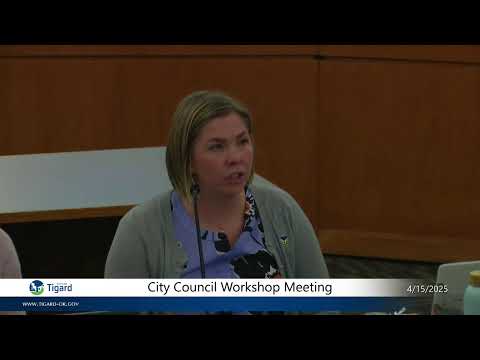
The Family Justice Center (FJC) reported to the Tigard City Council on April 22 that it provided more services than in any prior year, serving 7,202 survivors across Washington County in 2024 and offering 11,691 services.
“Overall, we provided 7,202 survivors with 11,691 services in 2024,” Executive Director Rachel Schutz said during the annual report. Schutz said the center’s outreach and expanded programs helped more people find services.
Schutz highlighted several program changes and new partnerships last year: a legal-navigation collaboration with St. Andrew’s Legal Clinic, a higher-volume food-distribution partnership with the Oregon Food Bank that delivered about 22,000 pounds of food in 2024, and a survivor peer outreach group. She said 435 Tigard residents received services in 2024 and Tigard ranked as the center’s third-highest source of clients; those Tigard residents received 646 services, a 29 percent increase over 2023.
The FJC also described a countywide risk-assessment protocol used by law enforcement to assess imminent danger in domestic-violence calls; the assessment’s findings are shared with jails, courts, pretrial and probation to help supervision and offender accountability. Schutz said the coordinated approach coincided with an 80 percent reduction in domestic-violence homicides in 2024 compared with the county’s recent peak.
Schutz emphasized the center’s role in removing practical barriers to safety: providing food, diapers and basic supplies can help survivors remain safely separated from abusive partners. She said that survivor self-reports showed high levels of satisfaction: 99.4 percent reported receiving trauma-informed care while at the center and 100 percent reported receiving help to keep their family safe.
Why it matters: Domestic violence services intersect with public safety, social services and court systems. The FJC’s data show both an increased demand for survivor services and a focus on cross-system risk assessment and basic-needs support.
What’s next: The council did not vote on new funding at the meeting, but the report underscores service demand that could inform future budget and partnership decisions.
Source: Presentation by Rachel Schutz, Executive Director, Family Justice Center, to the Tigard City Council on April 22, 2025.